
∂ Derivative Calculator
Symbolic differentiation with step-by-step results
Derivative Calculator
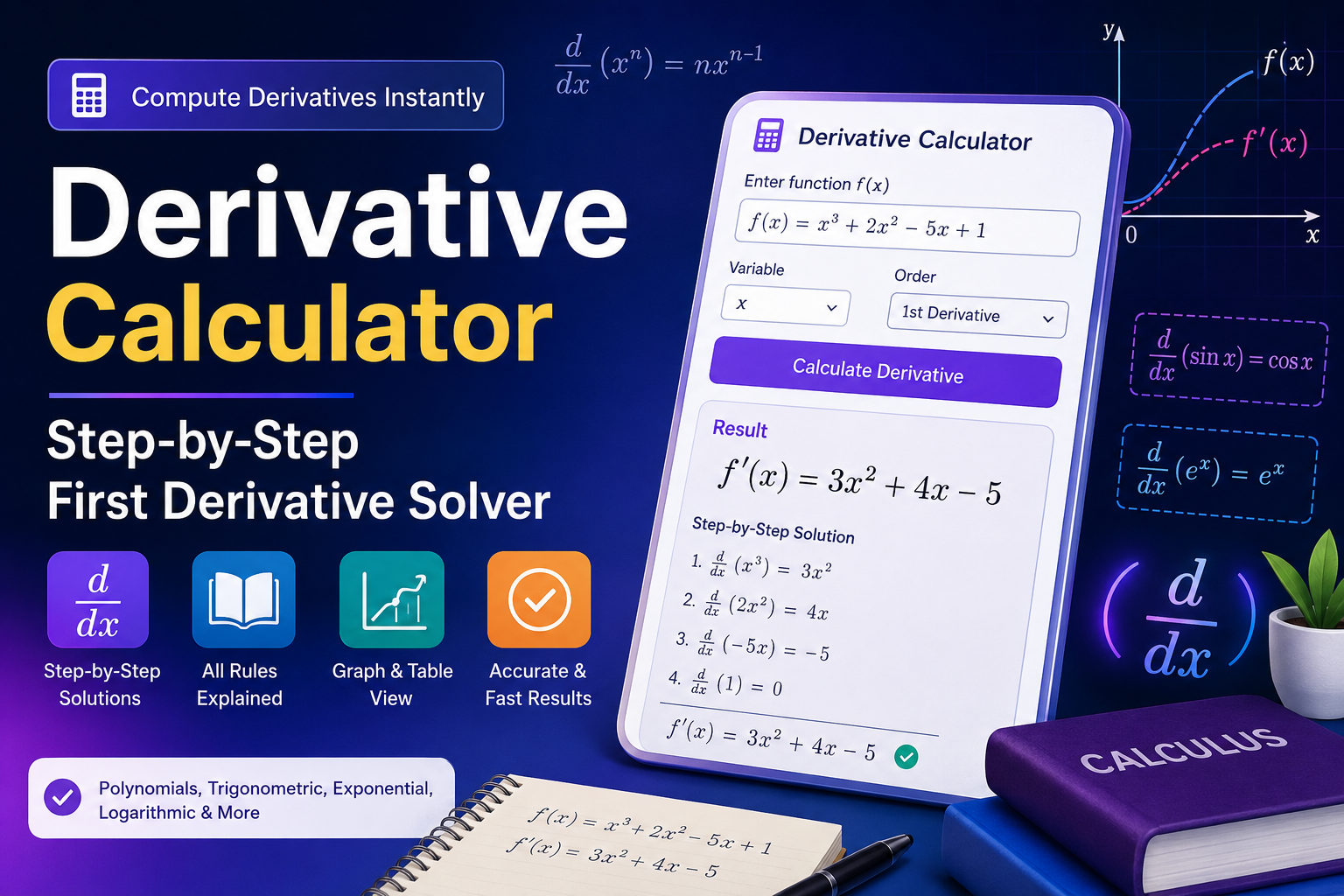
Calculus is one of the most important branches of mathematics, especially when it comes to understanding change, motion, optimization, and rates. Whether you are a high school student learning differentiation for the first time or an engineering student solving advanced calculus problems, a reliable Derivative Calculator can save time and reduce mistakes.
Our First Derivative Calculator helps you compute derivatives instantly while also displaying the rules and steps involved in the solution. It supports polynomial expressions, trigonometric equations, logarithmic functions, exponential equations, and much more.
f′(x)=limh→0hf(x+h)−f(x)
The formula above represents the formal definition of a derivative. While solving this manually is important for understanding the concept, calculators simplify lengthy computations and help students verify answers quickly.
What Is a Derivative?
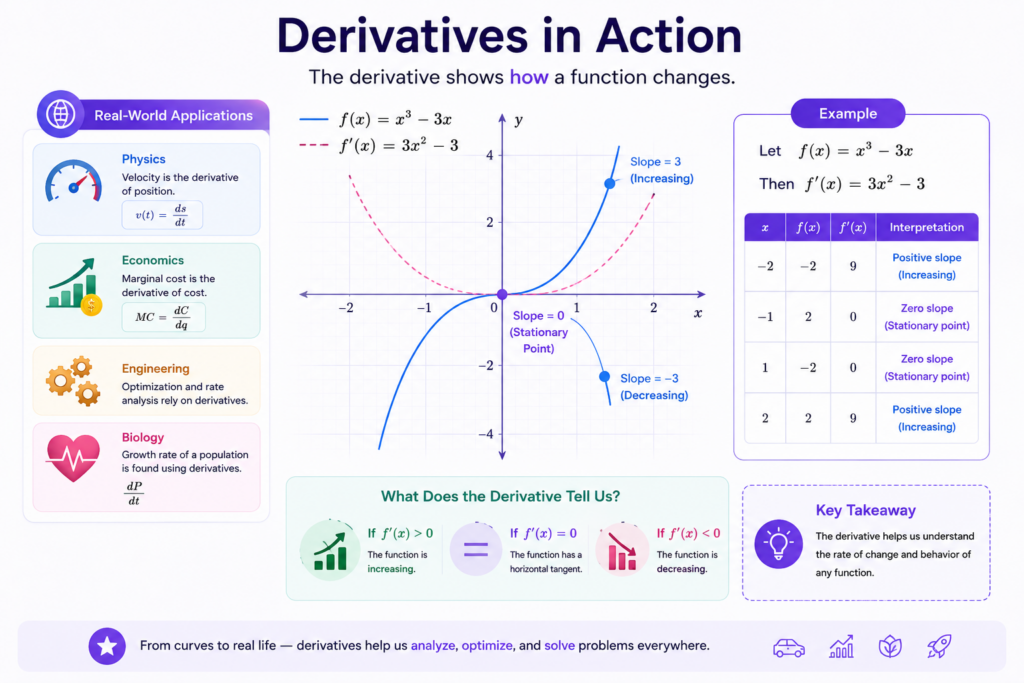
A derivative measures how a function changes with respect to a variable. In simpler terms, it tells you the rate at which something is increasing or decreasing.
For example:
- Speed is the derivative of distance with respect to time.
- Acceleration is the derivative of velocity.
- Marginal cost in economics is the derivative of cost functions.
If a function is written as:
Derivative Calculator
Calculus is one of the most important branches of mathematics, especially when it comes to understanding change, motion, optimization, and rates. Whether you are a high school student learning differentiation for the first time or an engineering student solving advanced calculus problems, a reliable Derivative Calculator can save time and reduce mistakes.
Our First Derivative Calculator helps you compute derivatives instantly while also displaying the rules and steps involved in the solution. It supports polynomial expressions, trigonometric equations, logarithmic functions, exponential equations, and much more.
f′(x)=limh→0hf(x+h)−f(x)
The formula above represents the formal definition of a derivative. While solving this manually is important for understanding the concept, calculators simplify lengthy computations and help students verify answers quickly.
What Is a Derivative?
A derivative measures how a function changes with respect to a variable. In simpler terms, it tells you the rate at which something is increasing or decreasing.
For example:
- Speed is the derivative of distance with respect to time.
- Acceleration is the derivative of velocity.
- Marginal cost in economics is the derivative of cost functions.
If a function is written as:
Its derivative becomes:
dxdy=2x
This means the slope of the curve changes depending on the value of x.
Why Use a Derivative Calculator?
A Calculus Derivative Calculator is useful because differentiation problems can become complex very quickly. Instead of spending several minutes solving complicated equations manually, students and professionals can use an online tool to get accurate answers instantly.
Benefits of Using an Online Derivative Solver
1. Saves Time
Complex differentiation problems involving trigonometric or logarithmic expressions can take a long time to solve manually.
2. Reduces Errors
Even a small algebraic mistake can produce the wrong derivative. A calculator helps verify your solution.
3. Step-by-Step Solutions
Many students struggle to understand how the answer was derived. This tool explains each step using calculus rules.
4. Useful for Homework and Exams
Students often use a Differentiate Functions Calculator to practice problems before exams.
5. Supports Advanced Functions
The calculator handles:
- Polynomial functions
- Trigonometric functions
- Hyperbolic functions
- Exponential equations
- Logarithmic equations
- Composite functions
How to Use This Derivative Calculator
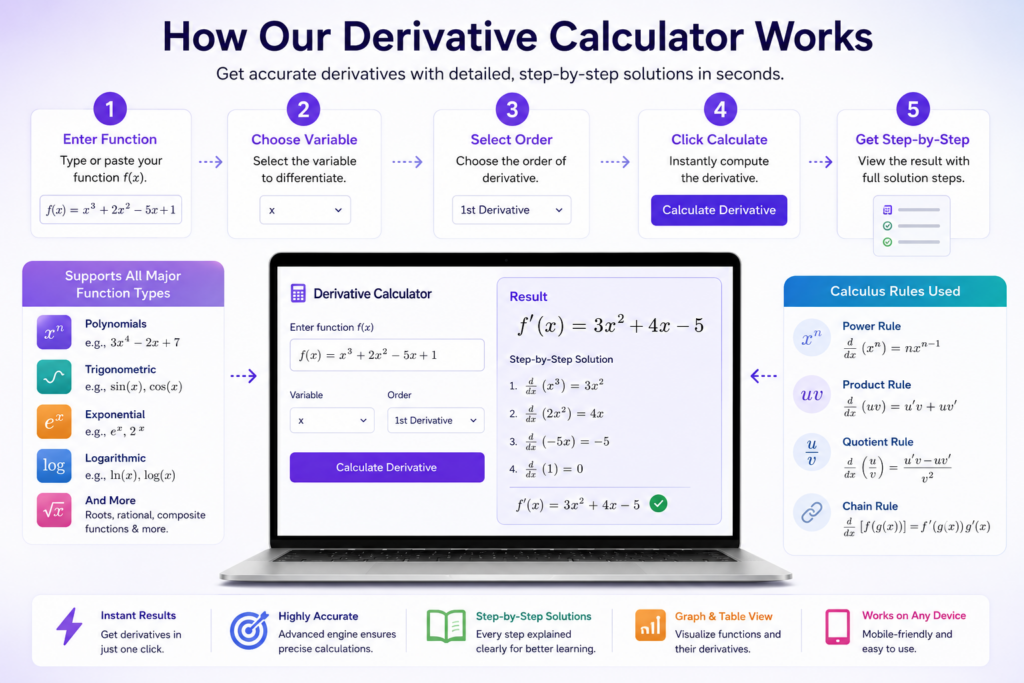
Using the calculator is straightforward. Follow these steps:
Step 1: Enter the Function
Type your mathematical expression into the input box.
Example:
- x2+5x+6
- sin(x)
- ex
Step 2: Select the Variable
Choose the variable with respect to which you want differentiation.
Usually:
- x
- y
- t
Step 3: Choose Derivative Order
Select whether you need:
- First derivative
- Second derivative
- Third derivative
- Higher-order derivatives
Step 4: Click “Calculate”
The calculator instantly computes the derivative.
Step 5: View Step-by-Step Explanation
You can expand the detailed solution to understand which differentiation rule was applied.
Common Differentiation Rules Used by the Calculator
The calculator automatically applies standard differentiation rules depending on the function entered.
1. Power Rule
Used for polynomial expressions.
dxd(xn)=nxn−1
Example
If:
Then:
f′(x)=5×4
2. Product Rule
Used when two functions are multiplied together.
dxd[u(x)v(x)]=u′(x)v(x)+u(x)v′(x)
Example
Differentiate:
Derivative:f′(x)=2xsin(x)+x2cos(x)
3. Quotient Rule
Used for division of functions.
dxd(vu)=v2u′v−uv′
Example
f(x)=xx2+1
Derivative:f′(x)=x22x(x)−(x2+1)(1)
4. Chain Rule
Used for composite functions.
dxd[f(g(x))]=f′(g(x))⋅g′(x)
Example
f(x)=sin(x2)
Derivative:f′(x)=cos(x2)⋅2x
Examples Solved Using the Derivative Calculator
Example 1: Polynomial Function
Find the derivative of:
Solution
Apply the power rule term by term:f′(x)=9×2+4x−5
Example 2: Trigonometric Function
Differentiate:
Solution
f′(x)=cos(x)−sin(x)
Example 3: Exponential Function
Differentiate:
Solution
f′(x)=ex
Example 4: Logarithmic Function
Differentiate:
Solution
f′(x)=x1
Real-Life Applications of Derivatives
Derivatives are not limited to classrooms. They are used across science, engineering, economics, and technology.
Physics
Used to calculate:
- Velocity
- Acceleration
- Motion
Engineering
Helps in:
- Structural optimization
- Signal processing
- Electrical systems
Economics
Used for:
- Marginal cost
- Profit maximization
- Revenue analysis
Machine Learning
Optimization algorithms heavily depend on derivatives and gradients.
Biology
Growth rates and population modeling use calculus concepts extensively.
Difference Between First and Second Derivative
The First Derivative Calculator measures the rate of change.
The second derivative measures how quickly that rate itself changes.
For example:f(x)=x3
First derivative:f′(x)=3×2
Second derivative:f′′(x)=6x
Tips for Solving Derivatives Faster
Here are a few practical strategies students can use:
Memorize Basic Rules
Knowing standard derivatives speeds up calculations dramatically.
Simplify Expressions First
Reducing the equation before differentiation helps avoid algebra mistakes.
Practice Composite Functions
Chain rule problems appear frequently in exams.
Verify Using a Calculator
A good Online Derivative Solver can confirm whether your manual solution is correct.
Common Mistakes Students Make
Forgetting the Chain Rule
Many students differentiate the outer function but ignore the inner derivative.
Incorrect Sign Usage
Trigonometric derivatives often involve sign changes.
Example:dxd(cosx)=−sinx
Algebraic Simplification Errors
Even correct differentiation can produce wrong final answers if simplification is incorrect.
Who Can Use This Calculator?
This tool is suitable for:
- High school students
- College students
- Engineering aspirants
- Competitive exam preparation
- Teachers
- Tutors
- Researchers
Advantages Over Manual Differentiation
| Feature | Manual Method | Derivative Calculator |
|---|---|---|
| Speed | Slow | Instant |
| Accuracy | Error-prone | Highly accurate |
| Step-by-step solutions | Limited | Available |
| Complex equations | Difficult | Easy |
| Learning support | Moderate | Excellent |
Frequently Asked Questions (FAQ)
What is a derivative calculator?
A derivative calculator is an online tool that computes derivatives of mathematical functions automatically.
Can this calculator solve higher-order derivatives?
Yes, it supports first, second, third, fourth, and fifth derivatives.
Does the calculator show steps?
Yes. It provides detailed step-by-step explanations using calculus rules.
Can it solve trigonometric functions?
Absolutely. Functions like:
sin(x)
cos(x)
tan(x)
are fully supported.
Why are derivatives important?
Derivatives are used to study rates of change, optimization, motion, and growth in mathematics and science.
Reference Links
- Khan Academy Calculus Resources
- MIT OpenCourseWare Calculus
- Paul’s Online Math Notes – Derivatives
- Wolfram Calculus Functions
Disclaimer
This derivative calculator is designed for educational and informational purposes only. While every effort is made to ensure computational accuracy, users should verify critical calculations independently, especially for academic submissions, professional engineering work, scientific research, or financial analysis.
Final Thoughts
A reliable Derivative Calculator can dramatically simplify calculus learning. From basic polynomial differentiation to advanced chain rule applications, this tool helps students solve equations faster while understanding the logic behind every step.
Whether you are preparing for exams, checking homework, or learning calculus concepts for the first time, an efficient First Derivative Calculator can improve both accuracy and confidence in solving mathematical problems.
The combination of instant computation, graphical interpretation, and step-by-step explanations makes this calculator an essential learning resource for anyone studying calculus.