Power Series Calculator
Mathematics becomes significantly easier when complex calculations can be solved instantly. One concept that often confuses students and even professionals is the idea of power series. Whether you are studying calculus, advanced algebra, engineering, or data science, understanding power series is essential.
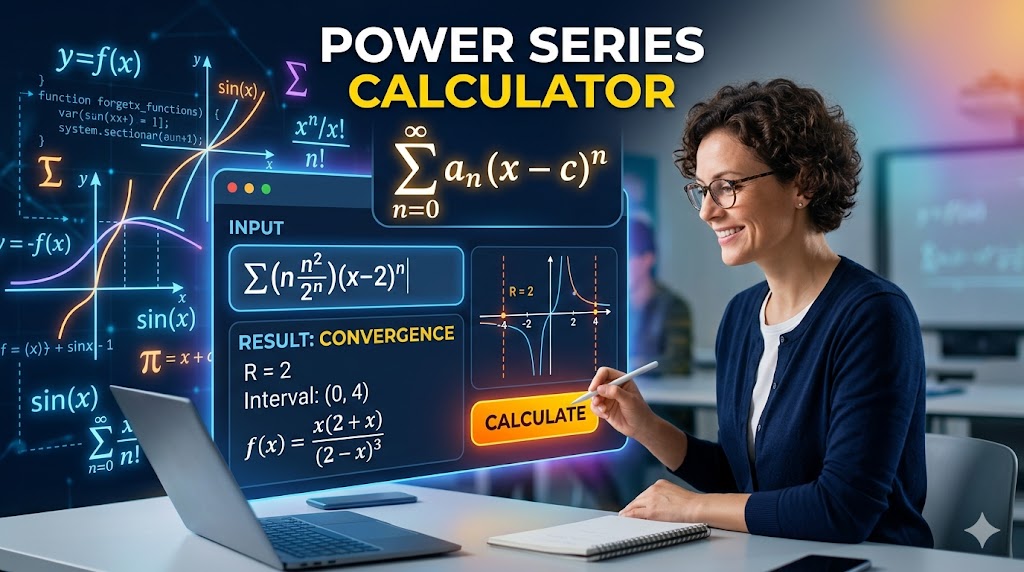
A Power Series Calculator helps simplify these calculations by automatically evaluating the sum of a series for a given value of x and a selected number of terms.
The calculator attached above allows users to quickly calculate finite approximations of power series without manually performing repetitive calculations.
In this guide, you will learn:
- What a power series is
- How the calculator works
- Power series formulas
- Real-world applications
- Examples and step-by-step solutions
- FAQs
- Common mistakes to avoid
- Reference resources
Table of Contents
What Is a Power Series?
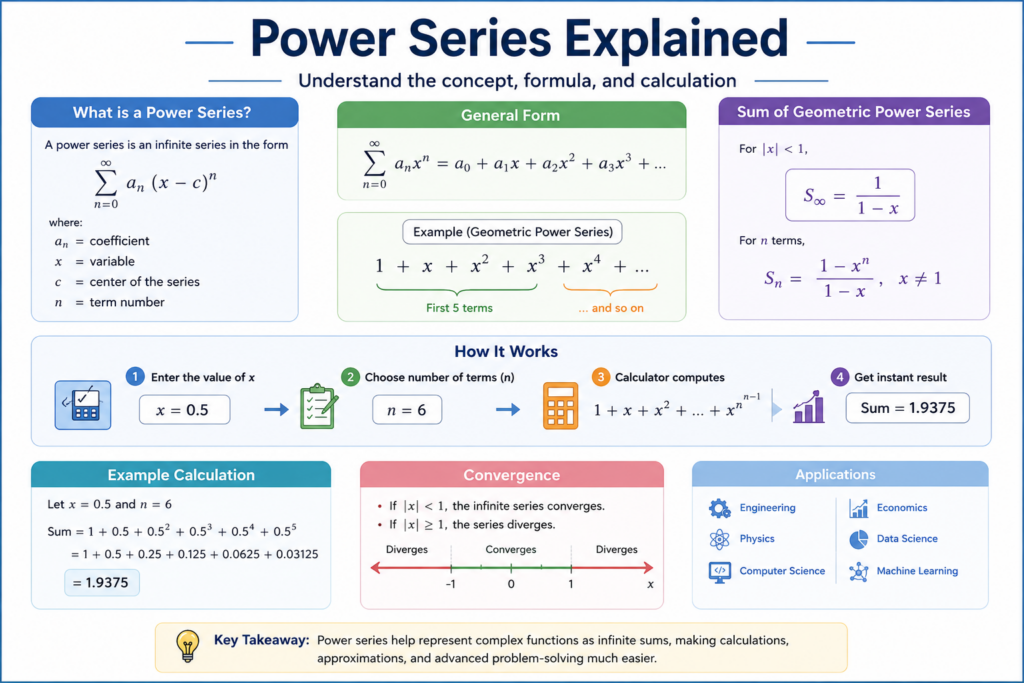
A power series is an infinite mathematical series written in the form:
∑n=0∞an(x−c)n
Where:
- an = coefficients
- x = variable
- c = center of the series
- n = term number
In simpler words, a power series represents a function as the sum of infinitely many polynomial terms.
Power series are widely used in:
- Calculus
- Physics
- Engineering
- Economics
- Computer science
- Machine learning
What Does This Power Series Calculator Do?
This Power Series Calculator evaluates the sum of a finite number of terms in a power series.
The calculator in the attachment computes:1+x+x2+x3+…
up to the selected number of terms.
It allows users to:
- Enter a value for x
- Choose the number of terms
- Instantly calculate the result
This saves time and reduces manual calculation errors.
Why Use a Power Series Calculator?
Solving power series manually can become tedious, especially when:
- The number of terms is large
- Decimal values are involved
- Repeated calculations are required
A calculator provides:
- Instant answers
- Better accuracy
- Faster learning
- Improved productivity
It is especially helpful for students preparing for:
- Calculus exams
- Engineering entrance tests
- Competitive mathematics exams
Steps to Use This Calculator
Using the calculator is straightforward.
Step 1: Enter the Value of x
Input the desired value of x.
Example:
x = 2Step 2: Enter Number of Terms (n)
Choose how many terms should be included in the series.
Example:
n = 5This means the calculator will compute:1+x+x2+x3+x4
Step 3: Click “Calculate”
Press the calculate button to instantly generate the sum.
Step 4: Review the Result
The calculator displays the final answer immediately.
Example Calculations
Example 1: Basic Power Series
Suppose:
- x = 2
- n = 5
The series becomes:
1+2+22+23+24
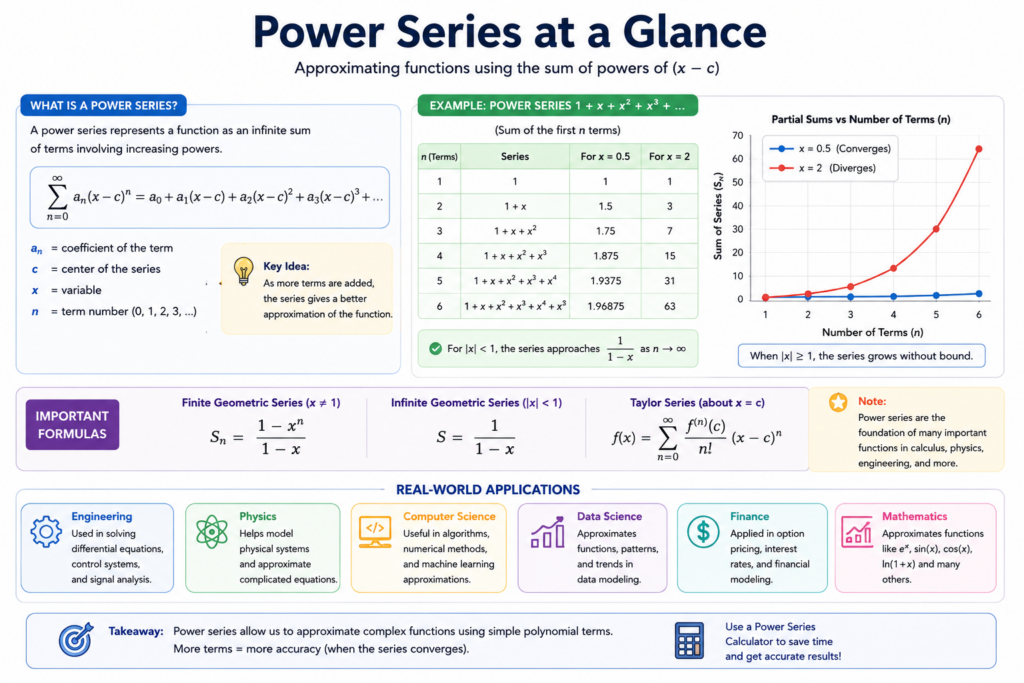
Which equals:1+2+4+8+16=31
The calculator computes this instantly.
Example 2: Decimal Value of x
Suppose:
- x = 0.5
- n = 6
The series becomes:1+0.5+0.25+0.125+…
The result converges quickly because the value of x is less than 1.
Example 3: Negative Values
Suppose:
- x = -1
- n = 4
The series becomes:1−1+1−1
The calculator handles alternating values automatically.
Understanding the Power Series Formula
The finite geometric power series formula is:
Sn=1−x1−xn
This formula works when:x=1
It helps calculate the sum without expanding every term manually.
Infinite Power Series
When the number of terms becomes infinite, the geometric series converges only if:
∣x∣<1
In that case, the infinite sum becomes:
S=1−x1
This concept forms the basis of many advanced mathematical models.
Real-Life Applications of Power Series
Power series are not just theoretical concepts. They are heavily used in real-world applications.
1. Engineering
Engineers use power series for:
- Signal processing
- Control systems
- Numerical approximations
2. Physics
Power series help solve:
- Differential equations
- Quantum mechanics problems
- Motion calculations
3. Computer Science
Used in:
- Algorithm analysis
- Machine learning models
- Numerical computation
4. Finance
Economists and financial analysts use series for:
- Compound interest calculations
- Investment growth prediction
- Financial modeling
5. Data Science
Power series support:
- Predictive analysis
- Statistical modeling
- Approximation methods
Difference Between Power Series and Taylor Series
Many users confuse these concepts.
Power Series
General representation of functions as infinite sums.
Taylor Series
A specific type of power series centered at a point.
Taylor series formula:
f(x)=∑n=0∞n!f(n)(a)(x−a)n
This is why many users search for a Taylor series calculator along with a power series calculator.
Common Mistakes While Using Power Series
1. Using Too Few Terms
Small values of n may produce inaccurate approximations.
2. Ignoring Convergence Conditions
Infinite series only converge when:∣x∣<1
3. Incorrect Input Values
Entering invalid or extremely large values may produce misleading results.
4. Confusing Infinite and Finite Series
The calculator shown above evaluates a finite number of terms.
Benefits of Using an Online Infinite Series Calculator
An online infinite series calculator provides several advantages.
Faster Calculations
Instant answers without manual work.
Better Learning
Students understand patterns more effectively.
Improved Accuracy
Reduces calculation errors.
Mobile-Friendly
Can be used on smartphones and tablets.
Useful for Homework
Ideal for assignments and practice sessions.
Power Series in Calculus
Power series are a major topic in calculus.
They help:
- Approximate difficult functions
- Solve integrals
- Simplify derivatives
- Analyze convergence
Common calculus functions represented using series include:
- Exponential functions
- Logarithmic functions
- Trigonometric functions
Geometric Series and Power Series
A geometric series is one of the simplest forms of a power series.
Example:
1+x+x2+x3+…
This is why users often search for:
- Geometric series calculator
- Infinite series calculator
- Power series calculator
These concepts are closely related.
Practical Tips for Students
To improve understanding:
- Practice small examples first
- Learn convergence rules
- Understand geometric progression
- Verify answers using the calculator
- Focus on pattern recognition
Frequently Asked Questions (FAQs)
What is a power series calculator?
A Power Series Calculator computes the sum of a series using a selected number of terms and a user-defined x value.
What is the difference between finite and infinite series?
Finite series contain a limited number of terms, while infinite series continue indefinitely.
Can power series represent functions?
Yes. Many mathematical functions can be expressed as power series.
What happens if x is greater than 1?
The series may diverge rapidly depending on the formula used.
Is this calculator accurate?
Yes. The calculator uses standard mathematical computations for accurate results.
Can I use decimal values?
Absolutely. The calculator supports decimal and negative inputs.
Why are power series important?
They simplify complicated functions and help solve advanced mathematical problems.
Reference Links
- Khan Academy Calculus Resources
- MIT OpenCourseWare Mathematics
- Wikipedia Power Series
- Paul’s Online Math Notes
Disclaimer
This calculator is intended for educational and informational purposes only. While every effort has been made to ensure accuracy, users should independently verify results before applying them in academic, engineering, financial, or research-related work.
Final Thoughts
A reliable Power Series Calculator makes mathematical computations easier, faster, and far more accessible. Instead of manually calculating lengthy expansions, users can instantly evaluate series using just a few inputs.
Whether you are a student studying calculus, an engineer solving equations, or a researcher analyzing numerical approximations, this tool can significantly improve efficiency and understanding.
Using a well-designed infinite series calculator also helps build confidence in advanced mathematical concepts while saving valuable time.