
Binomial Distribution Calculator
Probability plays a major role in statistics, mathematics, finance, gaming, research, and real-life decision-making. Whether you are a student solving assignments, a teacher preparing examples, or a professional analyzing outcomes, understanding probability distributions can save a lot of time and confusion.
One of the most widely used probability models is the binomial distribution. Since manual calculations can become lengthy and error-prone, using a Binomial Distribution Calculator helps simplify the process and provides accurate results instantly.
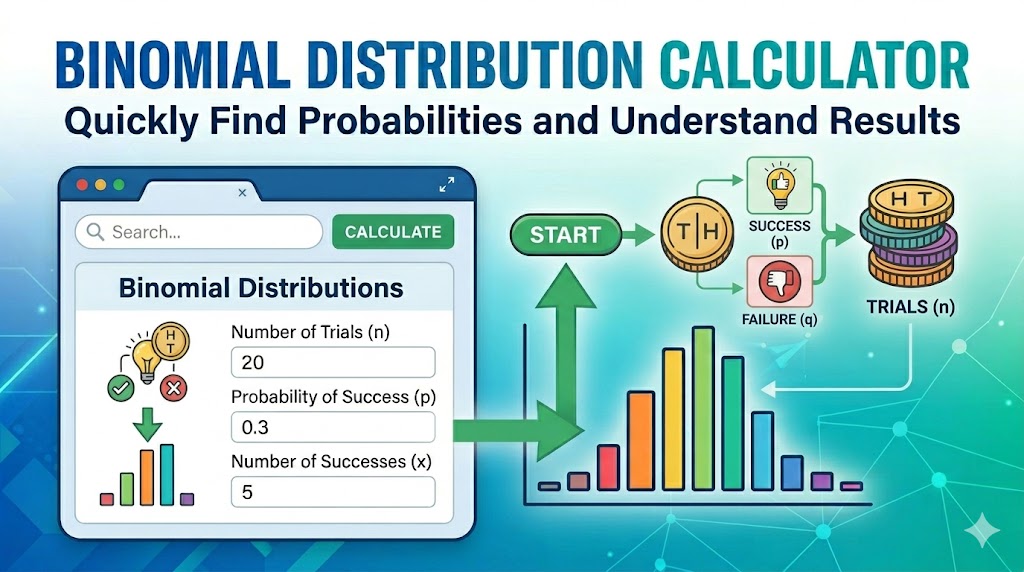
The calculator attached above allows users to quickly calculate the probability of achieving a certain number of successes in a fixed number of trials.
In this guide, you will learn:
- What binomial distribution means
- How the calculator works
- Steps to use the calculator
- Formula explanation
- Real-world examples
- FAQs
- Practical applications
- Common mistakes to avoid
Table of Contents
What Is Binomial Distribution?
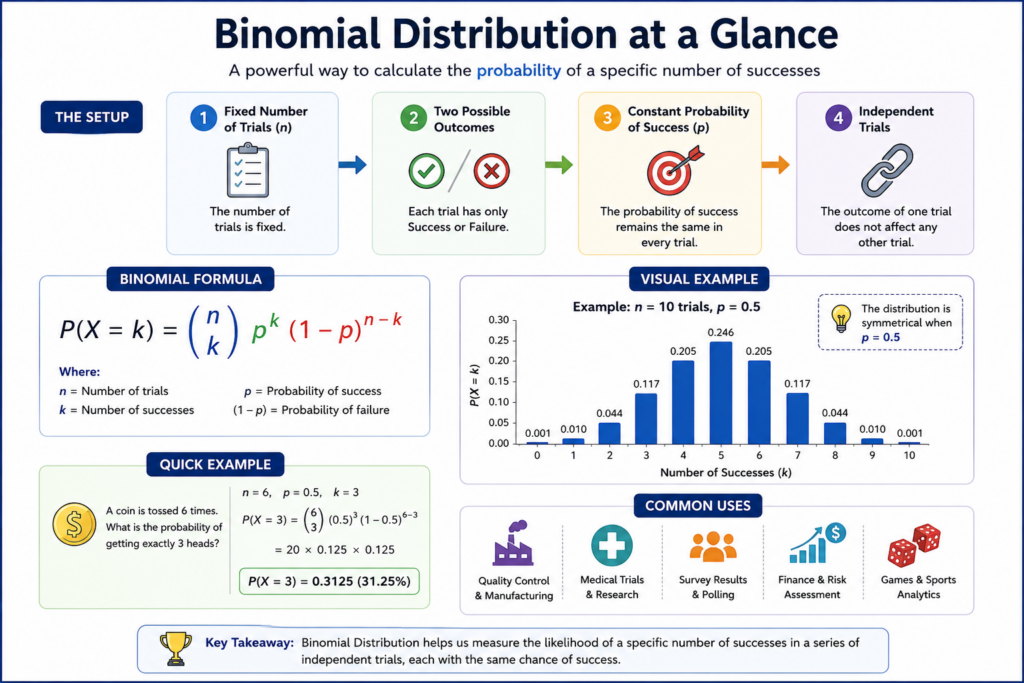
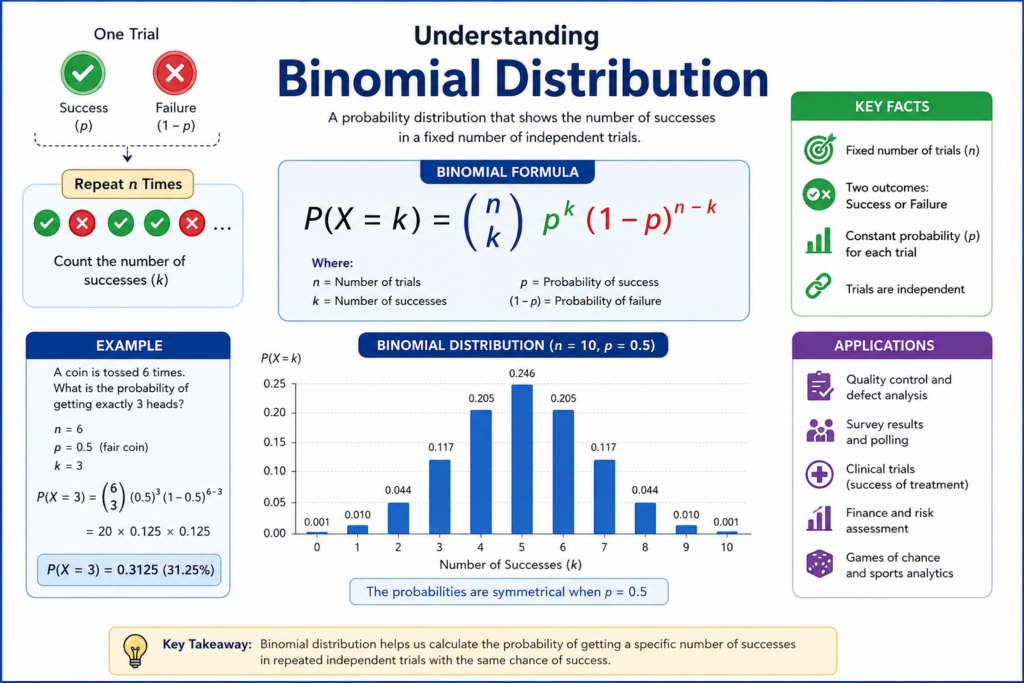
Binomial distribution is a probability distribution used when an experiment has:
- A fixed number of trials
- Only two possible outcomes
- Success
- Failure
- Equal probability in every trial
- Independent trials
For example:
- Tossing a coin
- Exam pass/fail results
- Product quality checks
- Winning or losing a game
The purpose is to determine the probability of obtaining exactly k successes in n trials.
Binomial Distribution Formula
The standard formula used is:
P(X=k)=(kn)pk(1−p)n−k
Where:
- n = number of trials
- k = number of successful outcomes
- p = probability of success
- P(X=k) = probability of getting exactly k successes
This is also known as the binomial probability formula.
What Is a Binomial Distribution Calculator?
A Binomial Distribution Calculator is an online statistical tool that computes the probability of a specific outcome without requiring manual calculations.
Instead of solving complex combinations and exponents manually, users simply enter:
- Number of trials
- Probability of success
- Desired number of successes
The calculator instantly displays:
- Exact probability
- Mean
- Variance
- Combination values
This makes it highly useful for:
- Students
- Statisticians
- Data analysts
- Researchers
- Financial professionals
Steps to Use This Calculator
Using the calculator is very simple.
Step 1: Enter Number of Trials (n)
Input the total number of trials or experiments conducted.
Example:
10 coin tossesHere:
n = 10Step 2: Enter Probability of Success (p)
Enter the probability of success in decimal form.
Examples:
0.5 = 50%
0.2 = 20%
0.75 = 75%
Step 3: Enter Number of Successes (k)
Input the exact number of successful outcomes you want to calculate.
Example:
3 successful eventsStep 4: Click “Calculate Probability”
The calculator will instantly display:
- Probability value
- Mean
- Variance
- Combination calculation
Example Calculations
Example 1: Coin Toss Probability
Suppose a fair coin is tossed 10 times.
You want to calculate the probability of getting exactly 5 heads.
Values
- n = 10
- p = 0.5
- k = 5
Using the calculator:
- Probability ≈ 0.2461
This means there is approximately a 24.61% chance of getting exactly 5 heads.
Example 2: Basketball Free Throws
A player has an 80% success rate in free throws.
If they attempt 6 shots, what is the probability they make exactly 4 shots?
Values
- n = 6
- p = 0.8
- k = 4
The calculator computes the probability instantly without lengthy manual calculations.
Example 3: Quality Testing
A factory knows that 5% of products are defective.
Out of 20 products tested, what is the probability exactly 2 are defective?
Values
- n = 20
- p = 0.05
- k = 2
The probability distribution calculator helps determine this within seconds.
Real-Life Applications of Binomial Distribution
The binomial probability calculator has applications in many fields.
1. Education
Students use it for:
- Statistics homework
- Probability assignments
- Exam preparation
2. Finance
Financial analysts use binomial models for:
- Risk estimation
- Investment probability analysis
- Market forecasting
3. Manufacturing
Factories use binomial probability for:
- Quality control
- Defect prediction
- Production analysis
4. Medical Research
Researchers apply binomial distribution in:
- Drug trials
- Treatment success analysis
- Disease probability studies
5. Sports Analytics
Sports analysts calculate:
- Win probabilities
- Shot success rates
- Performance prediction
Why Use an Online Binomial Distribution Calculator?
Manual probability calculations can become complicated, especially with larger values.
An online calculator provides several advantages:
Faster Results
Instant calculations save time.
Better Accuracy
Eliminates human calculation errors.
User-Friendly
No advanced statistical knowledge required.
Useful for Learning
Students can understand formulas through practical examples.
Mobile Accessible
Works on desktop, tablet, and smartphone devices.
Mean and Variance in Binomial Distribution
Apart from probability, the calculator also computes:
Mean Formula
μ=np
The mean represents the expected number of successes.
Variance Formula
σ2=np(1−p)
Variance measures how spread out the results are.
Common Mistakes While Calculating Binomial Probability
Many users make small mistakes while solving probability problems manually.
1. Using Percentage Instead of Decimal
Incorrect:
50Correct:
0.52. Entering k Greater Than n
The number of successes cannot exceed the number of trials.
Incorrect:
n = 5, k = 83. Confusing Independent Events
Each trial must remain independent.
4. Forgetting Exact Probability
Binomial distribution calculates the probability of exactly k successes, unless cumulative probability is specifically requested.
Advantages of Learning Binomial Distribution
Understanding binomial distribution improves analytical thinking and statistical reasoning.
It also helps in:
- Data science
- Machine learning
- Business analytics
- Competitive exams
- Financial modeling
Students preparing for exams like:
- SAT
- GRE
- GMAT
- CAT
- Statistical certifications
often encounter binomial probability questions.
How This Calculator Saves Time
Without a calculator, users need to:
- Compute combinations manually
- Calculate powers
- Multiply several values
- Verify accuracy
This process becomes difficult for large datasets.
The calculator automates everything instantly.
Frequently Asked Questions (FAQs)
What is binomial distribution used for?
It is used to calculate the probability of a fixed number of successes in repeated independent trials.
What are the conditions for binomial distribution?
The conditions are:
Fixed number of trials
Two possible outcomes
Constant probability
Independent trials
Can probability be greater than 1?
No. Probability always ranges between 0 and 1.
What is the difference between binomial and normal distribution?
Binomial distribution deals with discrete outcomes, while normal distribution is continuous.
Is this calculator accurate?
Yes. The calculator uses the standard binomial distribution formula to generate accurate probability values.
Can I use this calculator for exam preparation?
Absolutely. It is highly useful for statistics and probability practice.
What happens if k is larger than n?
The result becomes invalid because successful outcomes cannot exceed total trials.
Tips for Better Understanding
To master binomial probability:
- Practice with small examples
- Understand the formula structure
- Learn combinations
- Verify results using the calculator
- Apply concepts to real-world situations
Reference Links
- Khan Academy Probability Lessons
- Wikipedia Binomial Distribution
- NIST Engineering Statistics Handbook
- MIT OpenCourseWare Statistics Resources
Disclaimer
This calculator is intended for educational and informational purposes only. While every effort has been made to ensure calculation accuracy, users should independently verify results before using them in academic, professional, financial, or research-related decisions.
Final Thoughts
A reliable Binomial Distribution Calculator makes probability calculations much easier, faster, and more accurate. Instead of manually solving lengthy equations, users can instantly determine probabilities, mean values, and variance with just a few inputs.
Whether you are a student learning statistics, a teacher creating examples, or a professional working with probability models, this tool can significantly improve efficiency and understanding.
Using a modern probability distribution calculator also helps users visualize statistical concepts in a more practical and approachable way.