
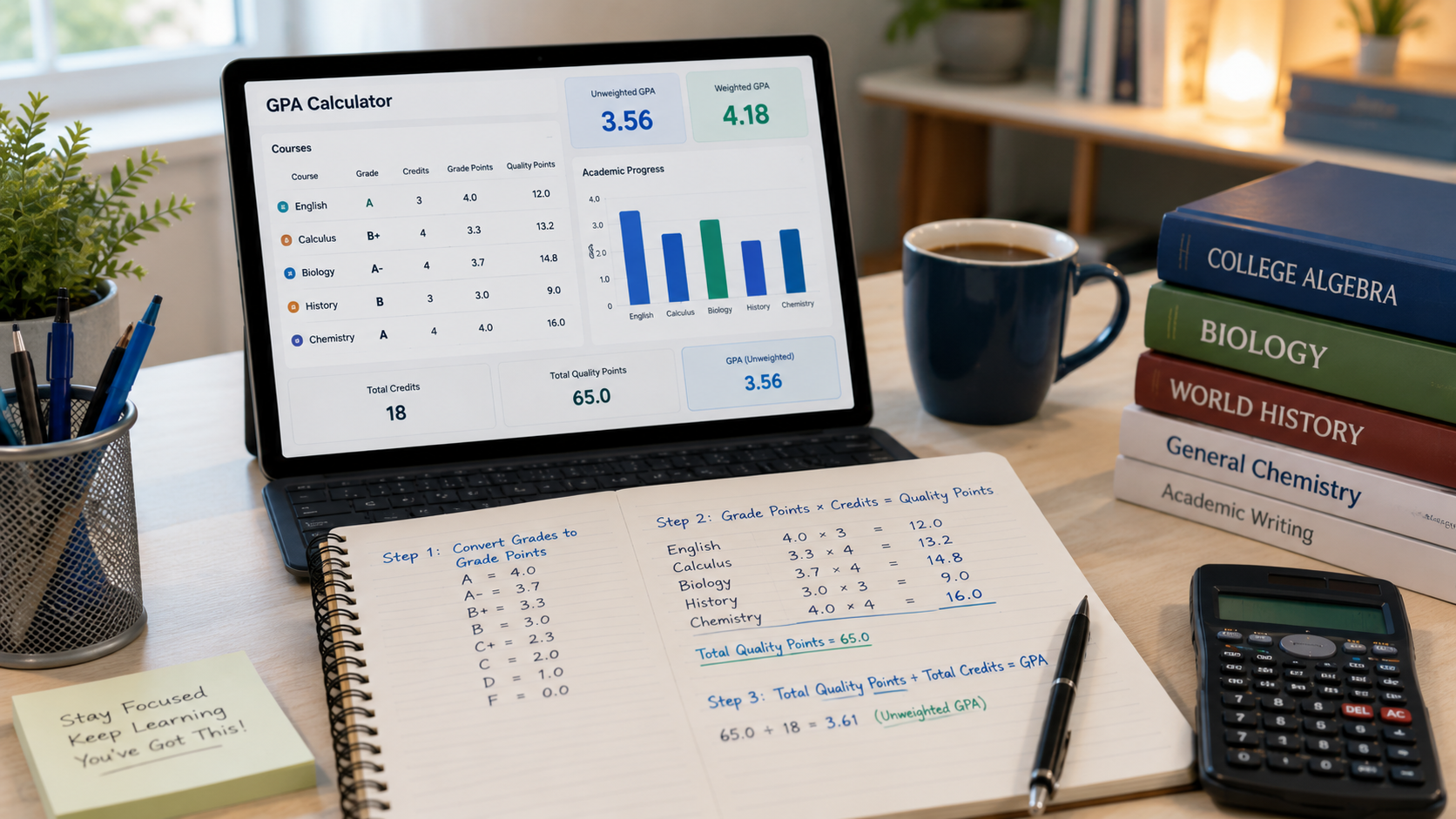
GPA Calculator
Calculate semester and cumulative GPA with support for both unweighted and weighted grading systems.
Your Courses
Add each course, select the grade and enter the credit hours.
Target GPA
Estimate the GPA required in future credits.
GPA Progress
Current GPA against a 4.00 scale.
Course Contributions
Quality-point contribution by course.
How GPA is calculated
GPA is calculated as total quality points divided by total credit hours. In unweighted mode, the standard 4.0 grade-point scale is used. In weighted mode, AP, Honors and IB courses can receive additional grade-point weighting according to the selected course type.
Import GPA Data
GPA Calculator Weighted Unweighted: Calculate Your GPA Easily
Your GPA is one of the simplest ways to summarize your academic performance, but calculating it is not always as straightforward as it looks. Different schools use different grading systems, some courses carry more credits than others, and advanced classes such as AP, Honors, and IB may receive additional weight.
That is why a GPA Calculator Weighted Unweighted can be useful when you want a quick and reliable estimate of your academic standing.
The calculator above lets you enter your courses, grades, credit hours, and course types to calculate your GPA. You can switch between weighted and unweighted calculations, see your total quality points, check your completed credits, and even estimate the GPA you may need in future courses to reach a target.
Whether you are a high school student checking your current grades, a parent helping a student understand their transcript, or someone preparing for college applications, understanding how GPA works can make academic planning much easier.
Table of Contents
What Is GPA?
GPA stands for Grade Point Average. It is a numerical representation of your academic performance based on the grades you receive in your courses.
On a traditional 4.0 scale, an A is commonly assigned 4.0 points, a B 3.0 points, a C 2.0 points, a D 1.0 point, and an F 0 points. Some schools also use plus and minus grades, such as A-, B+, or C-, with different point values.
However, there is no single GPA system used by every school. College Board notes that high schools can use different grading scales and that the traditional 4.0 scale is only one common example. Schools may also use different grade cutoffs and may or may not include plus and minus grades.
This is important because the GPA displayed on your transcript may not be calculated exactly the same way as the GPA calculated by an online tool.
The calculator on this page uses a commonly used GPA scale and provides both weighted and unweighted calculations. Your school’s official transcript should always be treated as the final source for your actual GPA.
Weighted vs. Unweighted GPA
One of the most common questions students have is: What is the difference between a weighted and unweighted GPA?
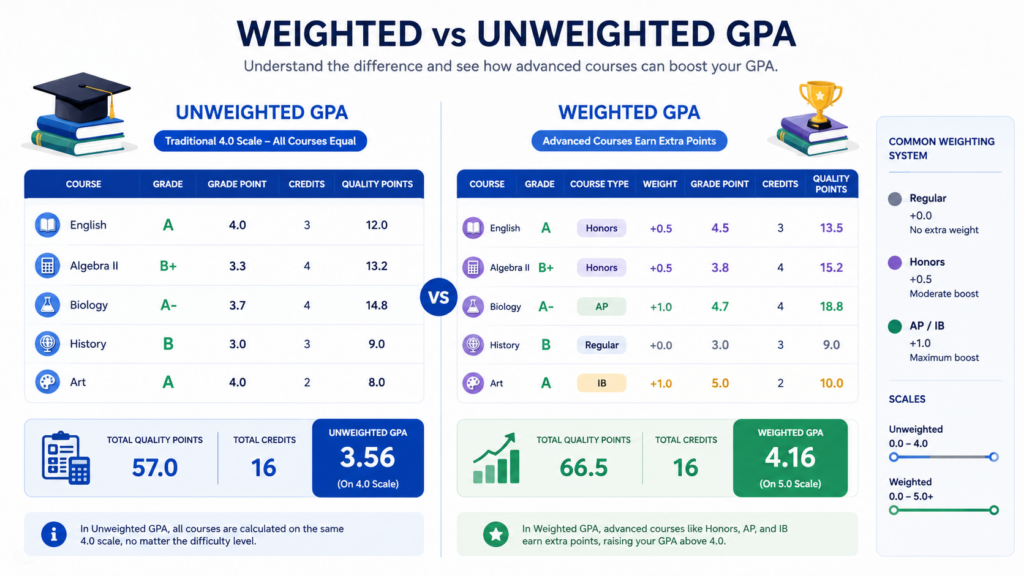
The main difference is whether advanced courses receive additional GPA points.
What Is an Unweighted GPA?
An unweighted GPA generally treats every course according to the same grading scale, regardless of whether the course is regular, Honors, AP, or another advanced level.
For example, under a traditional 4.0 system:
- A = 4.0
- A- = 3.7
- B+ = 3.3
- B = 3.0
- B- = 2.7
- C+ = 2.3
- C = 2.0
- C- = 1.7
- D = 1.0
- F = 0.0
If you receive an A in a regular mathematics course and an A in an Honors mathematics course, both may count as 4.0 in an unweighted calculation.
This makes an Unweighted GPA Calculator useful when you want to compare academic performance using a standardized 4.0-style scale without giving additional points for course difficulty.
What Is a Weighted GPA?
A weighted GPA gives additional points to certain advanced or more challenging courses.
For example, a school might assign:
- Regular A = 4.0
- Honors A = 4.5
- AP A = 5.0
The exact system varies from school to school. College Board describes weighted GPA as a system in which certain more difficult classes receive higher point values, with some schools assigning a 5.0 rather than 4.0 for an A in an AP class.
That means two students could both have earned mostly A grades but have different weighted GPAs because they took different levels of coursework.
How to Use the GPA Calculator
The calculator above is designed to make the process as simple as possible.
Step 1: Choose Weighted or Unweighted GPA
Start by selecting the calculation method.
Choose Unweighted GPA if your school does not add extra points for advanced courses.
Choose Weighted GPA if your school gives additional points to courses such as Honors, AP, or IB.
If you are unsure which system your school uses, check your transcript, student handbook, grading policy, or ask your school counselor.
Step 2: Add Your Courses
Click Add Course.
Enter the name of the course, such as:
- Algebra II
- Biology
- English
- Chemistry
- History
- Computer Science
You can add as many courses as necessary.
Step 3: Select Your Grade
Choose the grade you received for each course.
The calculator supports common letter grades including A+, A, A-, B+, B, B-, C+, C, C-, D+, D, D-, and F.
Remember that your school’s actual grade-point conversion may be different.
Step 4: Enter Credit Hours
Enter the number of credits associated with the course.
For example, if a course is worth 3 credits, enter 3.
Credit hours matter because a 4-credit course can have a larger effect on your overall GPA than a 1-credit course.
Step 5: Select the Course Type
When using weighted mode, select the appropriate course type:
- Regular
- Honors
- AP
- IB
The calculator applies the corresponding weighting system used by the tool.
If your school uses a different weighting policy, you should compare the result with your school’s official GPA calculation.
Step 6: Review Your GPA
The calculator automatically displays:
- GPA
- Quality points
- Total credits
- Number of courses
- GPA progress
- Course contributions
You can change grades or credits at any time and the result updates automatically.
How Is GPA Calculated?
The basic GPA calculation is straightforward:
GPA = Total Quality Points ÷ Total Credit Hours
Quality points are calculated by multiplying the grade points for a course by the number of credits.
For example, imagine you completed these three courses:
| Course | Grade | Grade Points | Credits |
|---|---|---|---|
| English | A | 4.0 | 3 |
| Mathematics | B | 3.0 | 3 |
| Biology | A- | 3.7 | 4 |
The quality points would be:
English:
4.0 × 3 = 12.0
Mathematics:
3.0 × 3 = 9.0
Biology:
3.7 × 4 = 14.8
Total quality points:
12.0 + 9.0 + 14.8 = 35.8
Total credits:
3 + 3 + 4 = 10
GPA:
35.8 ÷ 10 = 3.58
Therefore, the estimated GPA would be 3.58.
This credit-weighted method is particularly useful when courses have different credit values.
Weighted GPA Example
Now consider a student taking a mixture of regular, Honors, and AP courses.
Suppose the student’s school uses the following example weighting:
- Regular A = 4.0
- Honors A = 4.5
- AP A = 5.0
The student has:
| Course | Grade | Type | Credits |
|---|---|---|---|
| English | A | Regular | 3 |
| Mathematics | A | Honors | 3 |
| Biology | A- | AP | 4 |
| History | B+ | Regular | 3 |
Using the calculator’s example weighting:
English:
4.0 × 3 = 12.0
Mathematics:
4.5 × 3 = 13.5
Biology:
4.7 × 4 = 18.8
History:
3.3 × 3 = 9.9
Total quality points:
54.2
Total credits:
13
Weighted GPA:
54.2 ÷ 13 = 4.17
The weighted GPA is therefore approximately 4.17.
This illustrates why a weighted GPA can exceed 4.0.
However, do not assume that every school uses exactly the same weighting system. Your school’s official policy takes priority.
Why Do Schools Use Weighted GPAs?
The main purpose of weighting is to account for differences in course rigor.
An advanced course can require substantially more work than a standard course. Honors and college-level courses can involve deeper material, faster pacing, more difficult assignments, and additional academic expectations.
College Board notes that advanced classes can include Honors and college-level courses such as AP or IB, and some high schools provide additional GPA weight for these courses.
A weighted GPA can therefore provide additional context about the courses a student chose.
For example, consider two students:
Student A
- 5 regular courses
- Mostly A grades
- Unweighted GPA: 4.00
Student B
- 2 regular courses
- 2 Honors courses
- 1 AP course
- Mostly A grades
- Weighted GPA: potentially above 4.00
The numbers cannot be compared without understanding the grading system behind them.
This is one reason students should look beyond a single GPA number when evaluating academic performance.
Is a Higher Weighted GPA Always Better?
Not necessarily.
A weighted GPA can be higher because advanced courses receive additional points, but colleges do not all interpret weighted GPAs in exactly the same way.
College Board explains that colleges may recalculate GPA according to their own criteria. Some institutions may focus on particular subjects, remove non-core courses, or adjust weighting to make GPAs easier to compare across different schools.
In other words, a 4.4 weighted GPA from one high school may not be directly equivalent to a 4.4 weighted GPA from another school.
The course rigor, grading scale, transcript, school context, and the institution’s own evaluation process can all matter.
Yale, for example, states that its admissions committee evaluates applicants in the context of the many different curricular philosophies, course offerings, and grading policies found across secondary schools.
So, while GPA matters, it should not be viewed in isolation.
How Credit Hours Affect Your GPA
Credit hours are an important part of GPA calculations.
A course with more credits generally has a larger impact on your overall GPA.
For example, imagine you receive:
- A = 4.0 in a 1-credit course
- B = 3.0 in a 5-credit course
The B in the 5-credit course contributes much more to the total quality-point calculation because it carries more credits.
This is why simply averaging the numerical grades may produce an incorrect GPA when courses have different credit values.
The correct approach is to calculate quality points for each course and then divide the total quality points by the total credits.
How to Calculate Your Cumulative GPA
A cumulative GPA combines academic performance across multiple semesters or academic periods.
Suppose you have:
Semester 1
- GPA: 3.40
- Credits: 15
Semester 2
- GPA: 3.80
- Credits: 18
You should not simply calculate:
(3.40 + 3.80) ÷ 2 = 3.60
That only works when both semesters contain the same number of credits.
Instead, calculate the quality points.
Semester 1:
3.40 × 15 = 51.0
Semester 2:
3.80 × 18 = 68.4
Total quality points:
119.4
Total credits:
33
Cumulative GPA:
119.4 ÷ 33 = 3.62
So the cumulative GPA is approximately 3.62.
This is another reason why entering credit hours into a GPA calculator is important.
How to Use the Target GPA Feature
One useful feature of this calculator is the target GPA calculation.
Let’s say your current GPA is 3.20, you have completed 60 credits, and you want to finish with a 3.50 GPA.
You can enter your target GPA and the number of future credits you expect to complete.
The calculator estimates the average GPA you would need in those future courses.
This can help answer practical questions such as:
- What grades do I need next semester?
- Can I raise my GPA to 3.5?
- How many credits will affect my GPA?
- How much can my GPA improve before graduation?
- What GPA should I aim for in my remaining courses?
Keep in mind that the result is an estimate based on the information you enter. Your school’s official calculation may use different rules.
Can You Raise a Low GPA?
Yes, but the amount of improvement depends heavily on how many credits you have already completed.
If you have only completed a small number of courses, new grades can significantly change your cumulative GPA.
If you are close to graduation and have already accumulated many credits, improving the GPA becomes more difficult because each new course represents a smaller percentage of the total.
For example, raising a GPA from 2.5 to 3.0 after 20 completed credits is generally much easier than raising a GPA from 2.5 to 3.0 after 100 completed credits.
This is why it is better to monitor your GPA throughout high school rather than waiting until the final semester.
Weighted GPA Calculator vs. Unweighted GPA Calculator
Both tools answer slightly different questions.
An Unweighted GPA Calculator answers:
“What would my GPA be if every course were evaluated using the standard scale?”
A Weighted GPA Calculator answers:
“What would my GPA be if advanced courses receive additional points?”
Neither calculation is universally more correct.
The correct calculation depends on the grading policy used by your school.
If your school reports both weighted and unweighted GPA, it can be useful to track both.
The unweighted number makes it easier to compare raw grade performance, while the weighted number can show the effect of taking more challenging courses.
What GPA Is Considered Good?
There is no universal GPA that qualifies as “good.”
A 4.0 is traditionally considered excellent on an unweighted 4.0 scale, but students may have GPAs above 4.0 when their schools use weighted systems.
More importantly, GPA expectations vary by:
- School
- College
- Major
- Scholarship
- Academic program
- Course difficulty
- Grading system
A student’s transcript should therefore be considered in context.
College Board notes that grades are important in college applications, but colleges also consider the rigor of a student’s coursework and other parts of the application.
Rather than asking only whether a GPA is “good,” it can be more useful to ask whether the GPA is competitive for the specific colleges, scholarships, or programs you are interested in.
Do AP and Honors Classes Matter?
They can.
AP and Honors classes can demonstrate that a student chose more challenging coursework.
College Board explains that AP courses are college-level courses, while Honors courses are generally more rigorous high school courses. The two are not identical, although both can provide additional academic challenge.
Some schools also give additional GPA weight for these courses.
However, taking an advanced course simply to increase your weighted GPA is not always the best strategy.
A challenging schedule should still be manageable. Earning a very low grade in an advanced course may not necessarily be better for your academic record than performing strongly in an appropriately challenging schedule.
The right balance depends on your preparation, goals, school policies, and available courses.
Common GPA Calculation Mistakes
There are several mistakes students frequently make when calculating GPA manually.
1. Averaging letter grades directly
A, B, and C are not numerical values until they are converted into grade points.
2. Ignoring credit hours
A 4-credit course should not necessarily have the same effect as a 1-credit course.
3. Mixing weighted and unweighted points
Do not calculate some courses on a 4.0 scale and others on a weighted scale unless that is how your school’s system works.
4. Assuming every school uses the same scale
Different schools can have different grading policies.
5. Assuming AP always equals 5.0
Some schools give AP courses additional weight, while others use different systems or do not weight them at all.
6. Treating an online GPA calculator as your official GPA
An online calculator provides an estimate based on its assumptions and the information you enter.
Your transcript and school grading policy remain authoritative.
Tips for Improving Your GPA
If your GPA is lower than you want, focus on changes that can realistically improve your academic performance.
Prioritize difficult subjects
Identify the classes that are having the biggest impact on your GPA.
Track grades throughout the semester
Do not wait until final grades are released. Monitor assignments, tests, projects, and exams.
Understand your school’s weighting system
Knowing whether your school weights AP or Honors courses can help you interpret your GPA correctly.
Use your credit hours strategically
Higher-credit courses can have a greater effect on your cumulative GPA, so strong performance in those courses can be particularly valuable.
Ask for help early
Talk to teachers, tutors, academic advisors, or counselors when you start struggling instead of waiting until the end of the semester.
Set realistic targets
A goal such as moving from 3.1 to 3.3 may be more useful than simply aiming for a perfect 4.0 without considering your current academic record.

Frequently Asked Questions About GPA
What is a GPA?
GPA, or Grade Point Average, is a numerical representation of a student’s academic performance. It is calculated by converting grades into grade points and averaging those points, usually while accounting for course credits.
What is the difference between weighted and unweighted GPA?
An unweighted GPA generally uses the same grade-point scale for all courses. A weighted GPA gives additional points to selected advanced courses, such as Honors, AP, or IB, depending on the school’s policy.
Can a weighted GPA be higher than 4.0?
Yes. If a school gives additional points for advanced courses, students can have weighted GPAs above 4.0. Some schools use a 5.0 maximum, while others use different systems.
Is a 4.0 GPA good?
On a traditional unweighted 4.0 scale, a 4.0 represents the highest possible GPA under that system. However, GPA expectations vary between schools, colleges, programs, and grading systems.
Is weighted GPA better than unweighted GPA?
Neither is automatically better. They measure academic performance using different approaches. Weighted GPA considers course rigor through additional points, while unweighted GPA provides a simpler comparison of grades.
How do I calculate GPA with credit hours?
Multiply each course’s grade points by its credit hours. Add the resulting quality points and divide by the total number of credits.
GPA = Total Quality Points ÷ Total Credits
Does an A+ always equal 4.0?
No. Different schools may assign different values to an A+. Some schools treat A+ and A identically, while others use a different point value.
Do AP classes increase GPA?
They can, but it depends on your school’s grading policy. Some schools add extra GPA points for AP courses, while others use different weighting methods.
Do Honors classes increase GPA?
They may. Many schools provide additional weight for Honors courses, but this is not universal.
Can I use this calculator for college GPA?
Yes, as an estimate, provided you enter the appropriate grades and credit hours. However, colleges and universities can have their own GPA policies and grading scales.
How often should I calculate my GPA?
Checking your GPA at the end of each grading period or semester can help you understand your academic progress. You can also use the calculator to model potential grades before final exams.
Reference Links
The following resources can help you understand how GPA and course rigor are handled in different academic contexts.
- College Board – How to Calculate Your GPA on a 4.0 Scale
- College Board – Weighted vs. Unweighted GPA
- College Board – Is It Worth Taking Advanced Classes?
- Yale Undergraduate Admissions – Course Selection
These resources also illustrate why students should check the specific GPA and transcript policies used by their school and prospective colleges. College Board specifically notes that colleges may recalculate GPAs using their own criteria.
Final Thoughts
A GPA is more than just a number. It is a summary of your academic performance, but the meaning of that number depends on the grading system behind it.
A GPA Calculator Weighted Unweighted can make it easier to understand where your current GPA comes from and how individual grades affect your overall result.
Use the calculator above to enter your courses, grades, credit hours, and course levels. Try both weighted and unweighted modes if you are unsure which calculation best represents your academic record.
You can also experiment with different grades to see how future performance could affect your GPA. This can turn GPA calculation from a confusing end-of-semester task into a useful academic planning tool.
Most importantly, remember that there is no universal GPA formula. Schools can use different scales, weighting policies, grade conversions, and transcript rules. College Board recommends checking your school or college directly when you need an official interpretation of your GPA.
Use an online calculator for planning and estimation, but rely on your official transcript and school policies when submitting academic information for college admissions, scholarships, or other formal purposes.
Disclaimer
This GPA calculator and the information on this page are provided for educational and informational purposes only. The calculator uses a commonly used GPA methodology and may not exactly match the grading system used by your school, school district, college, university, or other institution.
Weighted GPA policies, grade-point values, credit calculations, rounding rules, repeated-course policies, AP/Honors/IB weighting, and transcript calculations can vary significantly between institutions.
The results generated by this calculator should therefore be treated as an estimate, not an official academic record. Always verify your GPA with your official transcript, academic advisor, counselor, school registrar, or institution before using it for admissions, scholarships, graduation requirements, or other formal purposes.