Loading AP Score Calculator. If nothing appears, please enable JavaScript.
You close your test booklet, shake out your writing hand, and walk out with one question stuck in your head: so what did I actually get? Official results don’t arrive until July, and that’s a long time to wonder. This is where an AP score calculator earns its keep. Type in roughly how many multiple-choice questions you got right and how many free-response points you think you earned, and you get a realistic 1 to 5 estimate in a few seconds.
The AP Score Calculator above covers 16 popular exams and has a custom mode for any course that isn’t listed. Below, I’ll show you how to use it, explain how scoring works behind the scenes, walk through a few real-number examples, and answer the questions students ask most often.
What Is an AP Score Calculator, and Why Use One?
An AP exam score calculator turns your raw points into an estimated final score. Raw points are what you earned in each section: correct multiple-choice answers, plus the points your free-response answers pick up. The calculator weights each section the way the exam does, adds them into a composite, and compares that total against a set of estimated cutoffs.
Students tend to use it at three moments:
- Right after the exam, to calm their nerves.
- During the school year, to score a practice test and see whether their prep is working.
- Before May, to work backwards: “I want a 4, so how many points do I need in each section?”
That last use is the most valuable. It turns a vague goal into a number you can actually study toward. The calculator also shows how far you are from the next score up. You can see at a glance whether you need a handful more multiple-choice answers or just one extra rubric point on an essay.
Table of Contents
How AP Exams Are Actually Scored
It helps to know what you’re estimating before you trust any estimate. Most AP exams have two parts, multiple choice and free response. A computer grades the multiple-choice section. Free-response answers are read by trained AP Readers, who are high school teachers and college faculty, and scored against a detailed rubric. For most exams, College Board describes your score as a weighted combination of those two sections. A few courses add other scored components, such as performance tasks.
So how are AP exams scored once both sections are marked? The two section scores are combined into one AP composite score, and the weights depend on the subject. AP Calculus AB is split roughly 50/50. The commonly cited formula multiplies the multiple-choice raw score by 1.2 and adds the free-response raw score, which gives a composite out of 108. AP Psychology puts about two-thirds of the weight on multiple choice. AP U.S. History spreads the weight across four pieces: multiple choice, short answers, the document-based question and the long essay.
The next step is where most people get confused. Your composite is not a percentage, and it isn’t converted with a fixed formula. College Board sets the cut points for each exam through a standard-setting process that uses studies and panels of educators. Those boundaries can shift a little from year to year. A composite that earned a 4 last year might land on a 3 or a 5 this year. That is why no calculator can promise your exact result, and why you should treat every estimate as a range rather than a verdict.
You also won’t see your composite on your score report. You only get the final number from 1 to 5, normally released in early July through your College Board account.
What Each AP Score Means
College Board describes the scale like this:
- 5: Extremely well qualified
- 4: Well qualified
- 3: Qualified
- 2: Possibly qualified
- 1: No recommendation
Many U.S. colleges give credit or advanced placement for a 3 or higher. Plenty of selective schools expect a 4 or a 5, and every college sets its own policy. The score that matters to you depends on where you’re applying.
How to Use the AP Score Calculator (Step by Step)
- Pick your exam. Open the dropdown and choose your subject. If your course isn’t there, choose “Custom exam” and enter your own section names, maximum points and weights.
- Enter your multiple-choice score. Type the number of questions you got right, or use the slider or the plus and minus buttons. Only correct answers count, and wrong answers don’t take points away.
- Add your free-response points. Grade your essays against the official scoring guidelines. Most students score themselves too generously, so if you’re torn between two scores, pick the stricter one.
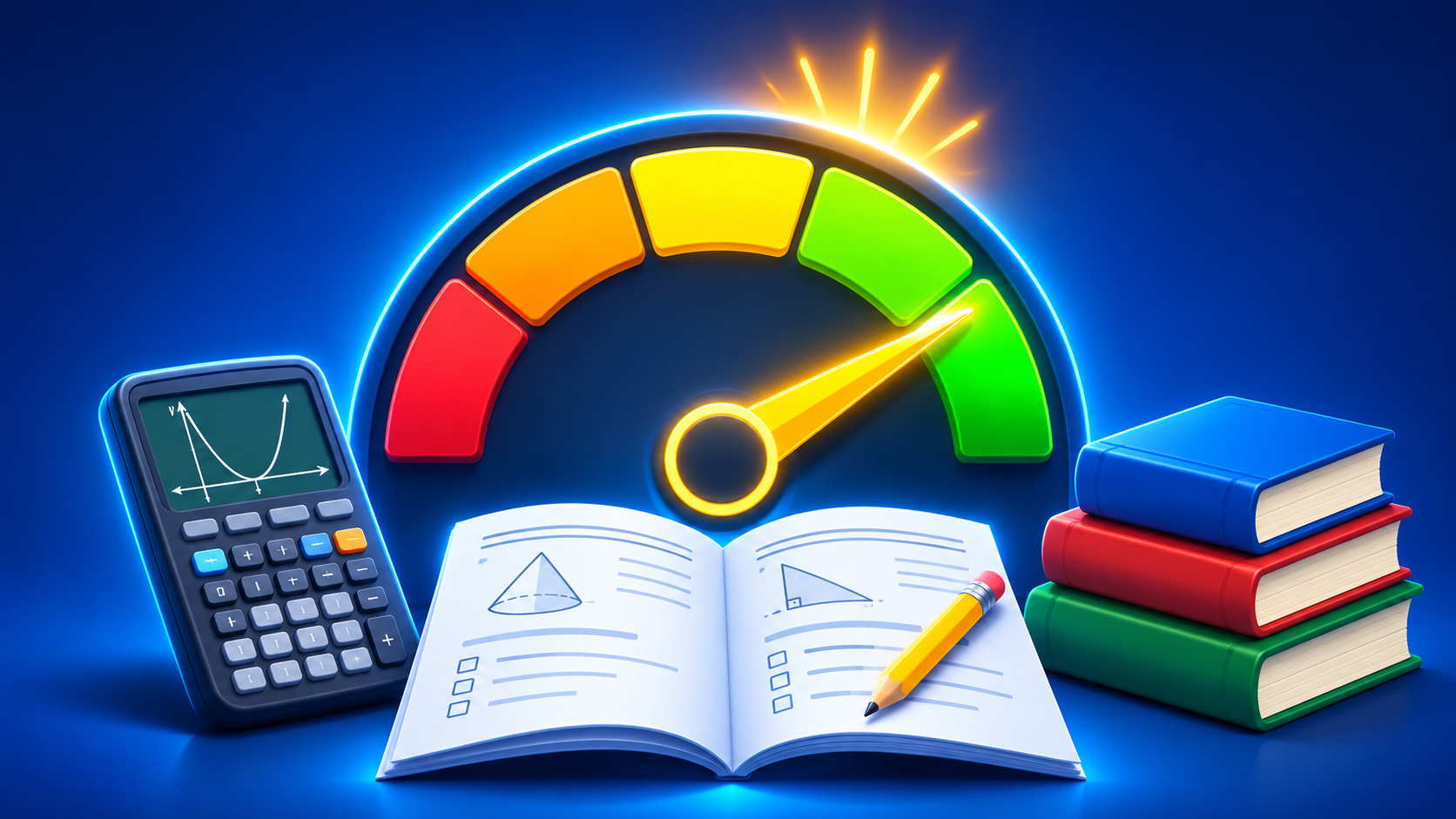
- Read your estimated score. The ring shows your 1 to 5 result, and the colored bar shows where your composite sits compared with each cutoff.
- Check the gap. The line under the bar tells you how many composite points separate you from the next score. It also shows which section changes would close that gap.
- Try the Target planner. Choose the score you want, and the planner shows what you’d need in each section to reach it.
- Tweak the cutoffs if you like. If your teacher has shared newer cutoff estimates, open “Edit score cutoffs” and change them.
- Save or copy your result. Saving lets you compare practice tests over time. Copying lets you send the result to a tutor or a friend.
Worked Examples
These examples use the calculator’s default estimated cutoffs, so your numbers may differ slightly if you change them.
Example 1: AP Calculus AB
Say you get 30 out of 45 on multiple choice and 24 out of 54 on free response. Each section is worth 50%, so multiple choice adds about 33.3 points and free response adds about 22.2. Your composite comes to roughly 55.6%, which lands in the 4 range. To reach a 5 you’d need about 7 more composite points. In real terms, that’s roughly 7 more multiple-choice answers or about 8 more free-response points.
Example 2: AP U.S. History
Imagine 33 out of 55 on multiple choice, 5 out of 9 on the short answers, 4 out of 7 on the DBQ and 3 out of 6 on the long essay. After weighting, your composite is about 56.9%, which is a 3. You’re only about 2 points short of a 4. Three more multiple-choice answers would do it, and so would a single extra rubric point on the DBQ, the short answers or the long essay. Seeing that is more motivating than staring at a vague “3.”
Example 3: Planning backwards in AP Biology
Say you want a 4, and your practice multiple-choice score is 34 out of 60. That section contributes about 28.3 points to your composite. If the estimated cutoff for a 4 is around 53%, you need roughly 24.7 more points from the free-response section. Free response is worth 50% of the composite and has 32 points available, so you’d need about 16 of those 32 points. That’s a clear target for your next round of essay practice.

What Is a Good AP Score?
There’s no single answer, because what is a good AP score depends on your goal.
A 3 is the usual benchmark for “passing,” and it’s the minimum many colleges accept for credit. A 4 or 5 opens more doors at selective schools and can place you out of introductory courses. If you aren’t chasing credit at all, any score that reflects solid effort in a hard class is a good one. A 2 on a very difficult exam isn’t a disaster.
Check the AP credit policy of each college on your list. Some give credit for a 3 in one subject but want a 5 in another, and some give placement without credit. Ten minutes on a college’s AP page will tell you more than any general rule.
How Accurate Is an AP Score Calculator?
It’s a good guide, but it’s not a prediction. Four things limit its accuracy:
- Cutoffs move. Official cut points aren’t published ahead of time and change with each year’s exam, so any calculator is working from estimates.
- Self-scoring is generous. Your own free-response scoring will probably run a little high, since you know what you meant to say.
- Practice tests differ. A practice exam may be easier or harder than the real thing.
- Exam structure changes. Section lengths and weights are occasionally updated, so check the latest course and exam description.
A simple habit helps. Run the calculator twice, once with your optimistic numbers and once with cautious ones. If both runs give the same score, you can feel fairly confident. If they differ by a point, you know exactly which section to work on.
Smart Ways to Raise Your Composite Score
- Never leave multiple choice blank. There’s no penalty for guessing, so every question is a free chance.
- Grab the cheap rubric points. On free response, setting up the problem, stating a clear thesis, or including units and labels often earns points even when the rest is shaky.
- Practice with official scoring guidelines. Past free-response questions and their rubrics are available on AP Central. Scoring your own work against them teaches you what Readers look for.
- Respect the weights. If one section is worth far more, it deserves more of your study time.
- Time yourself. Many students lose points because they run out of minutes, not because they lack knowledge.
- Track your trend. Run the calculator after every full practice test and save the result. A steady upward line is a better sign than any single number.

Frequently Asked Questions
Is this AP score calculator accurate?
It’s accurate enough to guide your study plan, but it isn’t official. It uses estimated cutoffs based on past patterns, and College Board decides the real boundaries each year. Treat the result as a range, not a promise.
How is the AP composite score calculated?
Your multiple-choice and free-response scores are weighted and added together. The weights vary by exam. Some are an even 50/50 split, and others lean more heavily on one section. The composite is then converted to a 1 to 5 score using cut points set by College Board.
What is a passing AP score?
Most people treat a 3 as passing. College Board calls it “qualified,” and many colleges give credit for a 3 or higher. Some schools require a 4 or 5, so check each college’s own policy.
Do wrong answers lower my multiple-choice score?
No. Only correct answers count toward your raw score, so answer every question.
When are AP scores released?
Scores are usually released in early July through your College Board account.
Why can the same composite give different scores in different years?
Cut points are set each year using standard-setting studies, and they can shift slightly. That’s why the calculator lets you edit the cutoffs.
Can I use the calculator for practice tests?
Yes, and that’s one of its best uses. Enter the raw points from a full practice test, then use the Target planner to see where you’re short. Be honest when you grade your own free-response answers.
Does a 5 require a perfect score?
Not at all. A 5 usually needs a solid share of the available composite points, but nowhere near all of them.
References
- College Board: About AP Scores
- College Board: AP Students
- AP Central (course and exam descriptions, past free-response questions and scoring guidelines)
- College Board: 2025 AP Exams Scoring Standards and Security
Disclaimer
This AP Score Calculator is an independent educational tool and is not affiliated with, endorsed by, or connected to College Board. AP is a registered trademark of College Board. The results are unofficial estimates based on approximate cutoffs and typical exam weightings. Actual composite scales and score cutoffs are decided by College Board each year and may differ. Always confirm exam structure and credit policies with College Board and with the colleges you plan to apply to. Your official AP score is the one shown in your College Board account.