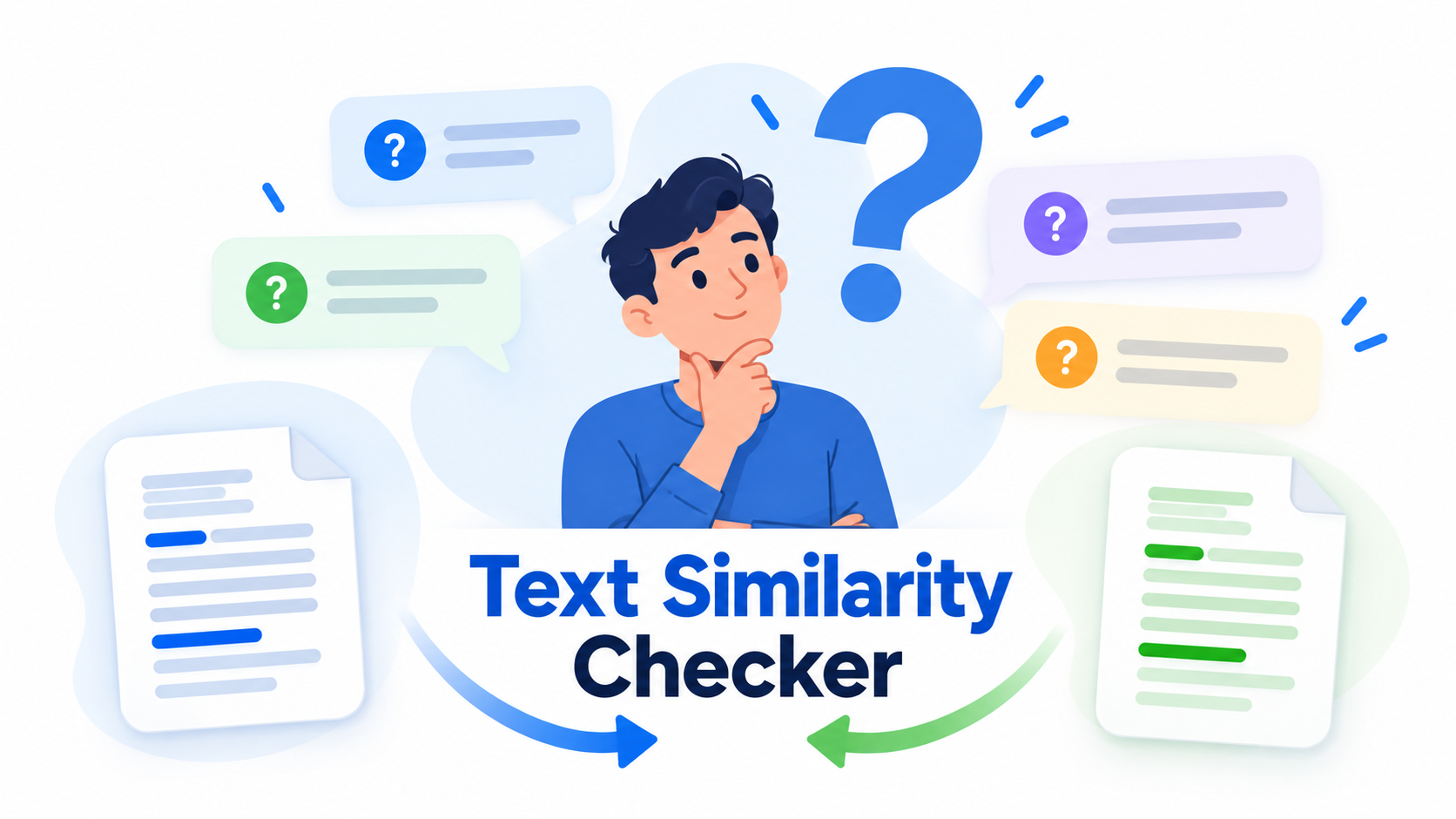
Text Similarity Checker
Compare two texts and discover how closely they match.
Please enter text in both boxes before comparing.
Comparison Results
Common words
Words unique to Text 1
Words unique to Text 2
Method: 70% word-set Jaccard similarity and 30% character-bigram Dice similarity. This is a text overlap estimate, not an AI plagiarism detector or a measure of semantic meaning.
Text Similarity Checker: Compare Two Texts Online for Free
Have you ever wanted to know how similar two articles, paragraphs, essays, or documents are? Whether you are a student checking an assignment, a blogger reviewing an article, a teacher comparing written work, or a content creator editing existing material, comparing two pieces of text can be a useful part of your workflow.
A Text Similarity Checker helps you compare two text samples and understand how much wording they have in common. Instead of manually reading both documents line by line, you can use an online text comparison tool to calculate a similarity percentage and identify shared and unique words.
Our free Text Similarity Checker makes this process simple. Paste your first text into Text 1, paste the second text into Text 2, and click the Check Similarity button. The tool analyzes the wording and displays a similarity score along with additional information about the two texts.
In this guide, you will learn how a text similarity checker works, how to interpret similarity percentages, when to use a text comparison tool, and why similarity scores should not be treated as definitive proof of plagiarism.
Table of Contents
What Is a Text Similarity Checker?
A Text Similarity Checker is an online tool that compares two pieces of written content and estimates how closely they match. Depending on the comparison method, it can analyze shared words, repeated phrases, character patterns, or other features of the text.
For example, imagine you have written an article about healthy eating and want to compare it with another article covering the same topic. Both articles might contain words such as nutrition, protein, vegetables, exercise, and health. A text similarity tool can help you examine the overlap between the two samples.
However, sharing individual words does not necessarily mean that two articles are copied from each other. Articles about the same subject naturally use similar terminology. That is why a similarity score should be interpreted in context.
A text comparison tool can be useful for:
- Comparing two versions of an article.
- Identifying repeated wording between documents.
- Reviewing assignments and written projects.
- Checking whether an edited paragraph differs from its original version.
- Finding common and unique words in two text samples.
- Reviewing content before publishing it on a website.
- Supporting proofreading and editorial quality checks.
The tool provided above is designed for quick comparisons without requiring an account, API key, or external text-processing service.
How to Use Our Free Text Similarity Checker
You do not need technical knowledge to use this tool. Follow these simple steps to compare your content.
Step 1: Enter your first text
Locate the Text 1 input box and paste the first paragraph, article, essay, or document excerpt you want to analyze.
You can use an original draft, an earlier version of your article, or another text that you are authorized to compare.
Step 2: Enter your second text
Paste the other text into the Text 2 input box. For example, you could compare your original article with its revised version or compare two different introductions written about the same topic.
For meaningful results, use complete and representative passages rather than comparing a full article against only one short sentence.
Step 3: Click Check Similarity
Click the Check Similarity button to run the comparison. The tool analyzes the two text samples and calculates a percentage based on its word and character comparison methods.
Step 4: Review the similarity score
The results section displays a percentage indicating the estimated similarity between the two texts. It also provides an interpretation of the score to help you understand the degree of textual overlap.
Remember that the score represents the particular comparison method used by this tool. It is not a universal measure of plagiarism, originality, or meaning.
Step 5: Examine common and unique words
The results also display common words, words unique to Text 1, and words unique to Text 2. These lists help you understand which vocabulary overlaps and which terms differ.
You can use the Swap Texts button to reverse the inputs, Clear All to start again, and Copy Results to copy the comparison summary.
How Does a Text Similarity Checker Work?
Text similarity can be calculated using several different mathematical and computational techniques. Each technique measures a different aspect of the text, so different tools may produce different scores for the same pair of documents.
The checker above combines two approaches: Jaccard similarity for word overlap and Dice similarity for character-bigram overlap.
1. Jaccard similarity
Jaccard similarity measures the intersection of two sets relative to their union.
In simple terms, it compares the unique words shared by two texts with all the unique words found across both texts.
The formula is:
Jaccard Similarity = Shared Unique Words ÷ Total Unique Words
Suppose Text A contains these words:
“Online tools help writers compare text.”
Text B contains:
“Writers use online tools to compare documents.”
The two texts share several words, including online, tools, writers, and compare. The Jaccard calculation measures the number of shared unique words against the combined set of unique words.
This method is useful for identifying vocabulary overlap. However, it does not fully account for word order, sentence structure, or the meaning of a passage.
2. Dice similarity using character bigrams
A character bigram is a pair of adjacent characters. For example, the word “text” contains the character bigrams “te”, “ex”, and “xt”.
The Dice similarity coefficient compares the character-bigram sequences of two text samples. It can identify similarities in spelling and character patterns, even when the wording is not completely identical.
The formula is:
Dice Similarity = 2 × Shared Bigrams ÷ Total Bigrams in Both Texts
This method can help detect small textual variations, such as changes in spelling, punctuation, or individual characters.
However, character overlap does not necessarily indicate that two passages have the same meaning. Two unrelated words can share several characters, and two sentences expressing the same idea can use very different wording.
3. Combining the two methods
The Text Similarity Checker combines the two scores using the following weighting:
- Jaccard word similarity: 70%.
- Dice character-bigram similarity: 30%.
The combined score is converted into a percentage and rounded to a whole number.
This approach gives greater weight to shared vocabulary while also accounting for character-level overlap. It is a practical, lightweight method for comparing text, but it is not equivalent to an advanced semantic similarity model.
How to Interpret Text Similarity Percentages
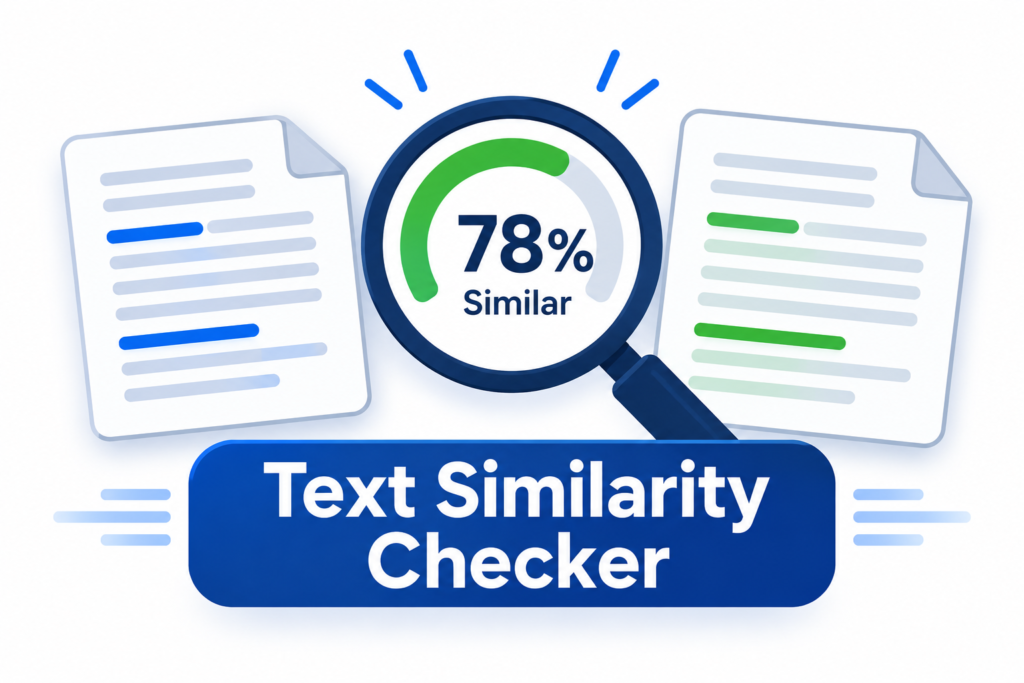
A similarity percentage is easier to understand when you know what it represents. The following table explains how the tool labels its results.
| Similarity score | Interpretation |
|---|---|
| 85%–100% | Very high similarity |
| 65%–84% | High similarity |
| 40%–64% | Moderate similarity |
| 20%–39% | Low similarity |
| 0%–19% | Very low similarity |
These ranges are descriptive categories used by this tool, not universally accepted academic or industry standards.
Very high similarity
A very high score indicates substantial overlap in the words and character patterns of the two text samples.
This can occur when you compare duplicate paragraphs, two versions of the same article, or a document with only minor edits.
If the result is unexpected, review the shared wording to determine whether the overlap is appropriate.
High similarity
A high score suggests that the texts share considerable vocabulary and character patterns. They may cover the same topic using similar expressions, or one may have been edited from the other.
Review the actual passages before drawing conclusions.
Moderate similarity
A moderate score suggests that the texts share some wording but also contain noticeable differences. This may happen when two articles discuss the same topic using overlapping terminology but different sentences.
Low similarity
A low score means the texts have relatively little overlap according to the selected comparison methods. They might discuss different subjects or use different vocabulary to explain similar ideas.
Very low similarity
A very low score indicates minimal overlap in the measured word and character patterns. It does not necessarily mean the texts express completely different ideas.
For example, two writers may describe the same event using different words and sentence structures. A basic text comparison tool may report low similarity even when the underlying meaning is similar.
Text Similarity Checker vs. Plagiarism Checker
A common question is whether a text similarity checker is the same as a plagiarism checker. Although the tools are related, they serve different purposes.
A basic text similarity checker compares the text you provide. It calculates an overlap score based on its selected algorithms and may display shared words or other textual features.
A plagiarism detection system may compare submitted content against a large collection of web pages, academic papers, publications, institutional documents, or previously submitted assignments. The coverage depends on the particular service.
| Feature | Text similarity checker | Plagiarism detection system |
|---|---|---|
| Compares two supplied texts | Yes | Often |
| Calculates textual overlap | Yes | Usually |
| Searches external content databases | Not in this tool | May do so |
| Identifies potential source matches | No | May do so |
| Understands meaning using AI | Not in this tool | Depends on the system |
| Provides definitive proof of plagiarism | No | No, human review is still needed |
The checker on this page does not search the internet or an external database. It only compares the two text samples you enter.
If you need to identify possible sources of copied content, use a plagiarism detection service that explicitly offers source matching. Even then, review the evidence and citations before deciding whether a passage constitutes plagiarism.
Benefits of Using an Online Text Comparison Tool
Saves time during editing
Comparing two long passages manually can be tedious. A text comparison tool provides a quick overview of shared wording and differences, allowing you to focus your attention on sections that need further review.
Helps compare document versions
Writers frequently revise introductions, conclusions, product descriptions, blog posts, and reports. Comparing an earlier draft with a revised version can help identify how much the wording has changed.
For detailed revision tracking, a dedicated document-diff tool may be more appropriate because it can highlight exact additions, deletions, and replacements.
Supports content quality checks
Bloggers and website owners can use text comparison to review repeated descriptions, overlapping paragraphs, and reused wording across drafts.
This is particularly helpful when several writers contribute to the same website and editorial consistency matters.
Makes textual overlap easier to understand
A percentage alone provides limited information. Lists of common and unique words offer additional context by showing some of the vocabulary responsible for the overlap.
Works without complicated setup
The checker runs directly in your browser. You do not need to register for an account, configure an API, or install additional software to perform a comparison.
Who Can Benefit from a Text Similarity Checker?
A text similarity tool can support a variety of writing and review tasks.
Students
Students can compare drafts of their own assignments to understand how revisions have changed the wording. They can also use text comparison as a learning aid when reviewing authorized source material.
A similarity percentage should not replace proper citation, academic integrity policies, or guidance from an instructor.
Teachers and educators
Educators may use text comparison as an initial screening step when reviewing two documents. However, a simple overlap score should not be used by itself to determine whether students have copied work.
Bloggers and content writers
Bloggers can compare article versions, review repeated passages, and identify similar wording between drafts. This can be especially useful when updating older posts or consolidating overlapping content.
SEO professionals
Search engine optimization professionals can compare titles, meta descriptions, product descriptions, and content drafts to identify repeated language.
The tool does not predict Google rankings or measure search engine penalties. It is simply a text comparison aid that can be incorporated into a broader content quality workflow.
Editors and proofreaders
Editors can use a similarity checker when reviewing multiple versions of a document or investigating possible duplicated passages.
For precise editorial review, combine similarity results with proofreading, document comparison, and direct examination of the original text.
Businesses and researchers
Teams can compare internal document drafts, proposals, reports, and authorized research materials. When documents contain confidential information, ensure that the selected tools and workflows comply with your organization’s data-handling requirements.
Text Similarity Checker for SEO and Blog Content
Website owners often want to understand whether two articles contain too much repeated wording. A text similarity checker can help with this initial review, particularly when comparing drafts, category descriptions, product pages, and articles covering related subjects.
However, textual overlap and search engine optimization are not the same thing.
Two articles about the same topic will naturally share important terminology. For example, several articles about keyword research may use phrases such as search volume, target keywords, search intent, and organic traffic.
The presence of these common terms does not automatically mean that the articles are duplicates or that either article will perform poorly in search results.
When reviewing content for SEO, consider the following practices:
- Give each article a clear purpose and search intent.
- Avoid publishing multiple pages that serve exactly the same purpose without a good reason.
- Use original examples, explanations, research, and practical insights.
- Review repeated passages in context rather than relying on a single percentage.
- Make titles, headings, and descriptions useful and relevant to each page.
- Consolidate overlapping pages when doing so improves the user experience.
The goal should be to create useful, accurate, and distinct content—not simply to achieve the lowest possible similarity score.
Limitations of This Text Similarity Checker
Although the tool is useful for basic comparisons, understanding its limitations is essential.
It does not understand meaning
The current implementation compares words and character patterns. It does not use a language model to determine whether two sentences express the same idea.
For example, “The weather is very hot today” and “Today’s temperature is extremely high” communicate similar ideas but use different words. A basic overlap algorithm may assign them a relatively low score.
It does not search the web
The checker does not look for matching articles on websites, compare your content against published books, or search academic databases.
It therefore cannot establish whether a passage originated from another source.
Results depend on the algorithm
Different tools use different methods, including word overlap, sequence matching, semantic embeddings, and document fingerprints. Their results are not necessarily comparable.
The percentage displayed by this tool should be understood as its own calculated score rather than a universal similarity measurement.
Common words can influence results
Words that appear in many documents can contribute to the overlap score. Similarly, short text samples can produce unstable or misleading results because a few shared words may have a substantial effect.
For better context, compare sufficiently long and representative passages.
It is not a substitute for detailed document comparison
The tool provides common-word lists and a summary score, but it does not highlight every matching sentence or show an exact side-by-side diff.
If you need detailed change tracking, use a dedicated text-diff or document comparison application.
Tips for Getting More Useful Results
To make your comparisons more meaningful, follow these recommendations.
Compare equivalent passages. When reviewing two articles, compare the full texts or similarly sized sections. Avoid comparing a long document with a very short excerpt unless that is your specific goal.
Check the actual wording. Read the common and unique word lists to understand the result. A score is more informative when you examine the content behind it.
Consider the context. Two documents about the same subject can share terminology without being copies of each other. Subject-specific vocabulary should be interpreted carefully.
Use the same text scope. If you are comparing document versions, include equivalent sections in both inputs. Differences in length and content can influence the score.
Do not optimize solely for a percentage. Replacing words with synonyms just to reduce a score can make writing less clear. Prioritize originality, accuracy, readability, and proper attribution.
Protect sensitive information. This tool processes the text locally in your browser and does not send it to an external API. Nevertheless, be mindful of your device, browser extensions, and other software when working with confidential material.
Frequently Asked Questions (FAQs)
1. What is a Text Similarity Checker?
A Text Similarity Checker compares two text samples and calculates an estimate of how closely they match. This tool uses word-set Jaccard similarity and character-bigram Dice similarity to produce a percentage and identify common and unique words.
2. Is this Text Similarity Checker free to use?
Yes. The tool provided on this page is free to use. You can enter two texts, calculate their similarity, review the results, and copy the comparison summary without an API key or paid subscription.
3. How accurate is the similarity percentage?
The percentage accurately reflects the result of the algorithm implemented in this tool, but it is not a universal measure of textual similarity. Other tools may produce different results because they use different algorithms or compare content against different sources.
4. Does a high similarity score mean plagiarism?
No. A high score indicates substantial overlap under the tool’s comparison method. It does not prove plagiarism, establish who wrote the text first, or determine whether a passage has been properly cited. Human review and source verification are necessary to evaluate possible plagiarism.
5. Can I compare two articles online?
Yes. Paste the first article into Text 1 and the second article into Text 2, then click Check Similarity. For the most useful comparison, use complete articles or representative sections of similar scope.
6. Does this tool check plagiarism on the internet?
No. This tool only compares the two texts you provide. It does not search Google, crawl websites, or compare your content with external publications or academic databases.
7. Can I use this tool for SEO content?
Yes. You can use it to review overlapping wording between blog drafts, page descriptions, product descriptions, and other website content. However, it does not predict search rankings, assess search intent, or determine whether Google considers a page valuable or original.
8. Does the tool support long text?
The tool uses browser-based text processing and does not impose a specific word limit in its interface. However, very large inputs can consume browser memory and processing time. For extremely long documents, compare smaller sections or use a dedicated document comparison application.
9. Is my text uploaded to a server?
The comparison logic in this tool runs locally in your browser. It does not send the entered text to an external API or comparison server. However, this does not guarantee that all other software on your device or website environment is free from data collection.
10. Can two texts have similar meanings but a low similarity score?
Yes. The tool measures word and character overlap rather than semantic meaning. Two passages can communicate the same idea using different vocabulary, sentence structures, or writing styles and still receive a low score.
11. What is the difference between Jaccard similarity and Dice similarity?
Jaccard similarity compares the intersection of unique word sets with their union. Dice similarity compares overlapping character bigrams relative to the total number of bigrams in both texts. This tool combines the two measures to account for both word overlap and character patterns.
12. Can I use the checker on a mobile phone?
Yes. The interface is responsive and adjusts to desktop computers, tablets, and mobile phones. On smaller screens, the two text input boxes appear vertically, making the tool easier to use on touch devices.
Disclaimer
The Text Similarity Checker is provided for general informational, educational, writing, and content-review purposes only. Its similarity percentage is an estimate generated using word-overlap and character-bigram comparison methods.
The tool does not determine plagiarism, authorship, copyright infringement, academic misconduct, or the originality of a document. It does not search external websites or databases and does not provide legal, academic, or professional judgments.
A high similarity score does not necessarily indicate plagiarism, and a low score does not guarantee that content is original. Users should review the actual text, verify relevant sources, follow applicable citation requirements, and comply with their institution’s or organization’s policies.
Although the tool performs comparisons locally in the browser, users remain responsible for the security of their devices and the suitability of any content they enter. The tool is provided on an as-is basis without a guarantee that its results will meet every user’s requirements. The website owner is not responsible for decisions or consequences arising from reliance on the calculated scores.
By using this tool, you acknowledge that its results are intended to support text review and should not be treated as definitive evidence or a substitute for appropriate human evaluation.