
Final Grade Calculator
Estimate your course grade or find out what you need on your final exam.
Your result
Common U.S. Letter Grade Reference
| Letter grade | Percentage | Typical GPA points |
|---|---|---|
| A | 93–100% | 4.0 |
| A− | 90–92.99% | 3.7 |
| B+ | 87–89.99% | 3.3 |
| B | 83–86.99% | 3.0 |
| B− | 80–82.99% | 2.7 |
| C+ | 77–79.99% | 2.3 |
| C | 73–76.99% | 2.0 |
| C− | 70–72.99% | 1.7 |
| D | 60–69.99% | 1.0 (typical) |
| F | Below 60% | 0.0 (typical) |
This is a general reference, not a universal grading policy. Some schools use different cutoffs, plus/minus grades, A+ grades, minimum passing scores, or GPA point values. Always check your course syllabus or institution’s official grading scale.
Final Grade Calculator: Calculate Your Course Grade and Required Exam Score
Keeping track of your grades throughout a school term or college semester can help you make informed decisions about studying, assignments, and exam preparation. Whether you are preparing for a high school final, a college midterm, or a university course assessment, knowing where you stand can make your next steps clearer.
Our Final Grade Calculator helps you estimate your overall course grade and work out the score you need on your final exam to reach a target percentage. Instead of manually calculating weighted averages, you can enter your current grade, the final exam's course weight, and your expected exam score or target grade.
The calculator is designed with students in the United States in mind, where courses commonly use percentages, letter grades, and, in many institutions, a 4.0 GPA scale. It can also help students in other countries who use percentage-based grading.
Remember that grading policies differ between schools, colleges, and universities. Use your course syllabus and your instructor's official grading rules whenever you need an authoritative result.
Table of Contents
What Is a Final Grade Calculator?
A Final Grade Calculator is an online tool that estimates your overall grade in a course based on your current performance and the weight of an upcoming or completed final exam.
For example, suppose your current course grade is 85%, and the final exam accounts for 20% of the overall course grade. If you score 90% on the exam, the calculator estimates how those results combine into your final course percentage.
The tool can also answer a different question: What grade do I need on my final exam to finish the course with an A, B, or another target percentage?
This second calculation is useful when you are planning your study time. It helps you understand whether your target is achievable under the grading assumptions you enter.
Who can use this calculator?
The calculator may be useful for:
- High school students tracking grades before semester or end-of-year exams.
- College students estimating final grades in individual courses.
- University students planning for weighted assessments.
- Students taking online courses with percentage-based grading.
- International students studying in the United States or at institutions that use letter grades.
- Parents and academic advisers helping students understand grading calculations.
The calculator provides an estimate, not an official grade issued by a school or university.
How to Use the Final Grade Calculator
You can use the tool in two ways, depending on the information you already know.
Option 1: Calculate your estimated final course grade
Choose Calculate Final Grade and enter the following information:
- Current grade: Enter your grade before the final exam, expressed as a percentage. For example, enter 85 for 85%.
- Final exam weight: Enter the percentage of the total course grade assigned to the final exam. If the exam accounts for 20% of your grade, enter 20.
- Final exam score: Enter the score you expect to earn or the score you received.
Select the calculation button to see your estimated overall course grade. The result also displays an approximate letter-grade equivalent based on the general U.S. reference scale shown in the tool.
Option 2: Find the score you need on the final
Choose Find Required Exam Score and enter:
- Your current course grade.
- The final exam's weight as a percentage of the course grade.
- Your target overall grade.
The calculator will estimate the score you need on the final exam to reach that target.
If the required score exceeds 100%, the tool will explain that the target is not mathematically achievable through the final exam alone under the entered assumptions. If your current performance already puts the target within reach, it will indicate that a score of zero on the final would still meet the target mathematically. However, check whether your course requires you to take the final or achieve a minimum exam score.
How Is a Final Course Grade Calculated?
When a final exam has a specific percentage weight, the overall course grade is a weighted average.
The formula is:
Final Course Grade = Current Grade × (1 − Final Exam Weight) + Final Exam Score × Final Exam Weight
For this formula, express the final exam weight as a decimal rather than a whole percentage. For example, a final exam worth 20% has a weight of 0.20.
Example: Calculating your final course grade
Imagine a student has the following results:
- Current grade: 85%
- Final exam weight: 20%
- Final exam score: 90%
First, convert the exam weight to a decimal: 20% = 0.20.
The remaining coursework accounts for 80% of the course grade, so the calculation is:
Final Course Grade = 85 × 0.80 + 90 × 0.20
Final Course Grade = 68 + 18
Final Course Grade = 86%
The student's estimated overall grade is 86%. On the example scale used by the calculator, that falls in the B range. The student's actual letter grade depends on the grading scale specified by the school or instructor.
How to Calculate the Grade You Need on Your Final Exam
You can reverse the weighted-grade formula to estimate the exam score needed for a target course grade.
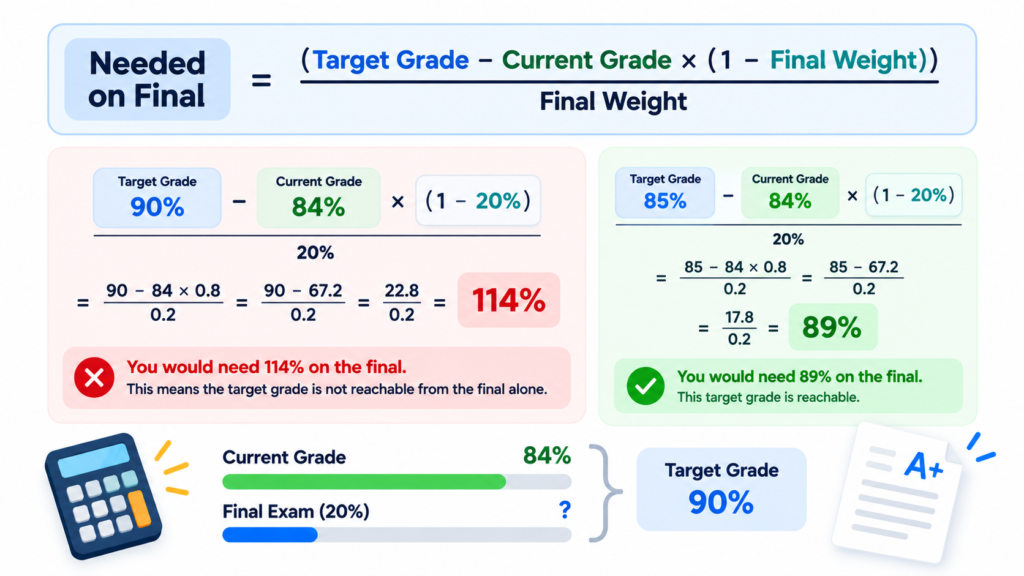
Required Final Exam Score = (Target Grade − Current Grade × (1 − Final Exam Weight)) ÷ Final Exam Weight
The final exam weight must be entered as a decimal.
Example: What do you need on the final to get a 90%?
Suppose your current grade is 85%, your final exam is worth 20%, and your target overall grade is 90%.
Using the formula:
Required Score = (90 − 85 × 0.80) ÷ 0.20
Required Score = (90 − 68) ÷ 0.20
Required Score = 22 ÷ 0.20
Required Final Exam Score = 110%
In this example, reaching 90% overall is not possible through the final exam alone if the maximum exam score is 100%. You may want to check whether your course allows extra credit, assignment corrections, or other opportunities to earn additional points.

Example: What if you want to finish with an 85%?
Keep the current grade at 85% and the final exam weight at 20%, but set the target overall grade to 85%.
Required Score = (85 − 85 × 0.80) ÷ 0.20
Required Score = (85 − 68) ÷ 0.20
Required Final Exam Score = 85%
You would need 85% on the final to finish with an 85% overall grade under these assumptions.
These examples show why the exam's weight matters. A final worth 10% has less influence on the course result than a final worth 40%.
Understanding Final Exam Weight
The final exam weight tells you how much the exam contributes to your overall course grade.
An exam worth 10% contributes one-tenth of the total course grade. An exam worth 30% contributes nearly one-third. The remaining percentage belongs to other course components, such as homework, quizzes, labs, projects, participation, and earlier exams.
Consider a student with a current grade of 80% who earns 90% on the final:
| Final exam weight | Estimated overall grade |
|---|---|
| 10% | 81% |
| 20% | 82% |
| 30% | 83% |
| 40% | 84% |
| 50% | 85% |
These results assume that the current grade represents all coursework outside the final exam and that the final is weighted exactly as entered.
When you read your syllabus, look for terms such as final exam weight, course assessment breakdown, grading policy, or weighted average. If your syllabus says that exams make up 40% of the grade and the final exam is only one part of that category, you may need a more detailed calculation.
Common U.S. Letter Grades and GPA
Many schools and colleges in the United States use letter grades such as A, B, C, D, and F. Some also use plus and minus grades, such as B+ or A−.
A common grading reference looks like this:
| Letter grade | Approximate percentage range | Typical GPA points |
|---|---|---|
| A | 93–100% | 4.0 |
| A− | 90–92.99% | 3.7 |
| B+ | 87–89.99% | 3.3 |
| B | 83–86.99% | 3.0 |
| B− | 80–82.99% | 2.7 |
| C+ | 77–79.99% | 2.3 |
| C | 73–76.99% | 2.0 |
| C− | 70–72.99% | 1.7 |
| D | Often 60–69.99% | Often 1.0 |
| F | Often below 60% | Often 0.0 |
This table is illustrative, not a universal U.S. grading standard. Some institutions use a 90–100% A range, omit plus and minus grades, assign different GPA points, or set a different minimum passing grade. Some courses also have special requirements that do not follow the general scale.
For an official answer, consult your institution's grading policy or course syllabus. A percentage-to-letter conversion should not be treated as an official GPA calculation unless it matches the rules your institution uses.
What is a 4.0 GPA scale?
Grade Point Average, commonly abbreviated as GPA, is a numerical representation of academic performance. Many U.S. institutions use a 4.0 scale for unweighted GPA calculations, with an A commonly worth 4.0 points, a B worth 3.0, a C worth 2.0, a D worth 1.0, and an F worth 0.0.
Plus and minus grades may receive intermediate values. However, policies differ. Some institutions award 4.0 points for an A and 4.0 for an A+, while others use a different value for an A+ or other grades.
A course grade percentage is not automatically the same as a GPA. Your school may convert a final percentage to a letter grade and then assign grade points according to its own policy.
Why Your Current Grade May Not Match Your Learning Platform
Students often view their grades in a learning management system such as Canvas, Blackboard, Moodle, or another online course portal. The displayed percentage may not always be the exact value needed for a final-exam calculation.
For example, your portal might show a current grade calculated only from completed assignments. Alternatively, it might count unsubmitted assignments as zeros or include a placeholder zero for the final exam.
Before entering your grade, check how the course system calculates it.
Questions worth checking include:
- Does the displayed grade include only completed assignments?
- Are missing assignments counted as zeros?
- Is the final exam already included in the grade calculation?
- Are assignments weighted equally, or are they grouped into categories?
- Are dropped quiz scores or extra-credit points included?
- Does the instructor round the final percentage?
If the final exam is already included as a zero in the displayed grade, entering that number as the current grade and then weighting the final exam again may produce an incorrect result. Follow the grading method in your course syllabus.
Weighted Grades Versus Points-Based Grades
Not every course calculates grades using a simple weighted average. Some instructors use a total-points system.
Weighted grading
In a weighted system, each category contributes a set percentage to the final grade. For example:
- Homework: 20%
- Quizzes: 15%
- Midterm exam: 25%
- Final exam: 40%
The categories add up to 100%. Each category's average is multiplied by its weight, and the weighted results are added together.
Points-based grading
In a points-based system, the instructor adds the points you earned and divides them by the total points possible.
For example, if you earn 420 points out of 500 possible points:
Percentage = (420 ÷ 500) × 100
Percentage = 84%
If your final exam adds another 100 points to a course that previously had 500 possible points, the final exam's contribution depends on the points earned and the new total. In this case, treating the final exam as a fixed 20% category would only be appropriate if the syllabus defines it that way.
When the syllabus uses points instead of fixed weights, calculate the points-based total rather than assuming a weighted average.
What If You Need More Than 100% on the Final?
A required score greater than 100% means your target overall grade cannot be reached through the final exam alone under the model you entered.
For instance, if you need 108% on a final exam to earn your target grade, a perfect 100% would not be enough under those assumptions.
You can take several practical steps:
- Recheck the inputs. Confirm your current grade, final exam weight, and target grade.
- Review your syllabus. Verify whether the final is weighted independently or as part of an exam category.
- Check for extra credit. Ask whether extra-credit work is available under your instructor's policies.
- Review incomplete coursework. If an assignment was recorded incorrectly or remains ungraded, clarify its status.
- Set a realistic target. Calculate what your course grade would be with a 90%, 95%, or 100% exam score.
The calculator cannot determine whether your instructor will offer extra credit or change a grade. Those decisions are governed by the course's official rules.
How to Use Your Results to Plan Study Time
A grade calculation can help you prioritize your preparation, but it should not be your only study strategy.
If you need a high exam score, review the course topics with the greatest impact on the exam and identify concepts you have not mastered. Practice questions under timed conditions, review instructor feedback, and use office hours or tutoring resources when available.
If your target is already within reach, continue preparing rather than assuming the result is guaranteed. Exam performance can vary, and some courses require students to sit the final or earn a minimum score on it regardless of their overall grade.
It may also help to calculate a few scenarios. Compare the overall course result if you earn 75%, 85%, 90%, or 100% on the final. Looking at multiple outcomes can provide a more balanced picture than focusing on a single target.
Use the results as a planning aid, not as a substitute for learning the material.
Common Mistakes When Calculating a Final Grade
1. Entering the exam weight incorrectly
If the final is worth 20% of the course grade, enter 20—not 0.20—because the calculator accepts a percentage.
2. Confusing exam score with overall grade
An 85% on the final exam does not necessarily mean your final course grade will be 85%. Your overall grade depends on your other coursework and the final exam's weight.
3. Using the wrong current grade
Check whether your displayed grade excludes missing assignments or already includes the final exam. A grade calculated from completed work may differ from the grade used in the official course total.
4. Assuming every school uses the same letter-grade scale
A 90% may be an A− at one institution and an A at another. Always check the relevant grading policy.
5. Ignoring rounding rules
Your instructor may round final percentages, or may not round them at all. Do not assume that a result of 89.5% automatically becomes 90%.
6. Forgetting minimum-exam requirements
Some courses require a minimum score on the final exam to pass the course. A weighted-average calculation alone cannot determine whether you meet such a requirement.
Frequently Asked Questions
1. How do I calculate my final grade?
Multiply your current grade by the portion of the course completed outside the final exam, multiply your exam score by the exam's weight, and add the two results. Make sure the final exam weight is expressed as a decimal in the formula.
2. How do I find out what grade I need on my final?
Enter your current grade, final exam weight, and target overall grade into the calculator's required-score mode. The tool calculates the exam percentage needed to reach your target under the entered assumptions.
3. Is this Final Grade Calculator free?
Yes. The calculator provided on this page is intended to be used free of charge, with no account required to perform the calculation.
4. Can I use this calculator for college courses?
Yes. It is suitable for college courses that use a current percentage grade and a final exam with a known course weight. Check your syllabus if your course uses a more complex grading method.
5. What is a good final grade in the United States?
There is no single answer for every school or program. Many U.S. grading references treat grades in the A range as excellent and B grades as good, but institutions and courses define their own thresholds and academic expectations.
6. Does an A always mean a 4.0 GPA?
No. An A is commonly worth 4.0 on many U.S. GPA scales, but grade-point policies differ. Some institutions assign a different value to A+ grades or use other GPA systems.
7. What if the calculator says I need more than 100%?
This means the target is not reachable through the final exam alone under the inputs you supplied. Recheck the calculation assumptions and review your syllabus for extra credit, incomplete assignments, or other grading rules.
8. Can this calculator determine my official grade?
No. It provides an estimate based on the information entered. Your instructor or institution determines the official grade using the course's grading policy.
9. Can I use it for high school grades?
Yes. It can help high school students estimate a semester or course grade when the final exam's weight and current grade are known. School-specific grading rules may still apply.
10. What if my course uses total points instead of weighted percentages?
The simple calculator may not match your course's method. For a points-based course, add the points earned and divide by the total points possible, including the final exam when appropriate.
11. Does the calculator round grades?
The calculator displays an estimated percentage to two decimal places. Your institution may use different rounding rules when assigning the official course grade.
12. What information should I check before using the calculator?
Confirm your current grade, the final exam's percentage weight, whether the final is already included in the displayed grade, and whether your course has special requirements such as minimum exam scores or dropped assignments.
Conclusion
A Final Grade Calculator can help you understand your current academic standing, estimate your overall course result, and identify the exam score needed to reach a target. It is especially useful when a final exam contributes a fixed percentage of your course grade.
Enter your figures carefully, compare different exam-score scenarios, and use the results to guide your preparation. For the most accurate interpretation, follow the grading rules in your course syllabus and the official policy of your school, college, or university.
Disclaimer: This tool is for educational planning and informational purposes only. It does not provide an official grade, guarantee an academic outcome, or replace your institution's grading policy. Results depend on the accuracy of the information entered and the assumptions described above.
References
- EducationUSA — U.S. Undergraduate Study
Background information on the U.S. higher-education system and academic assessment.
https://educationusa.state.gov/your-5-steps-us-study/undergraduate-study - University of California, Berkeley Global — GPA Calculation
An example of how a university explains letter grades and grade-point values, including differences in grading policies.
https://berkeleyglobal.zendesk.com/hc/en-us/articles/4641342156311-GPA-Calculation - University of Southern California — Grades
University information on grade assignment and numerical equivalents.
https://arr.usc.edu/grades-faculty-and-staff/ - Columbia University — Student Grades
Guidance on grade options and GPA calculation.
https://registrar.columbia.edu/content/student-grades - United States University — Grading System
An example of an institutional grading scale with percentage bands and quality points.
https://usuniversity.smartcatalogiq.com/en/current/general-catalog/academic-policies/grading-system/
Reference note: These sources illustrate grading practices at particular U.S. institutions. They do not establish one universal grading scale for all U.S. schools or universities.