
🧬 Punnett Square Calculator
Predict genetic cross outcomes for monohybrid and dihybrid crosses
Genetics often feels complicated when you first encounter terms like alleles, genotypes, and inheritance patterns. But once you visualize how traits are passed from parents to offspring, everything becomes much clearer. That is exactly what a Punnett Square Calculator helps you do.
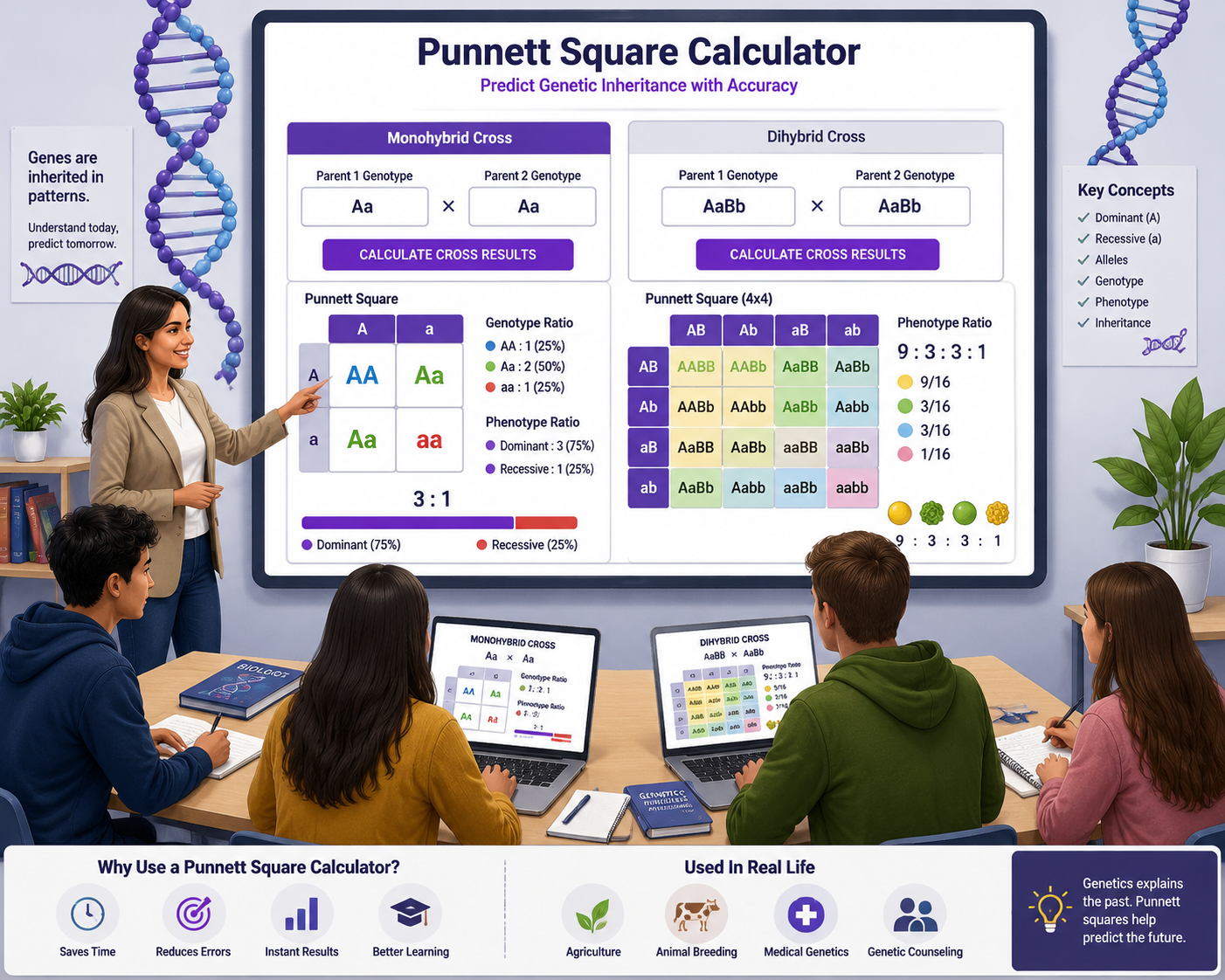
This tool simplifies genetic cross predictions by automatically generating possible offspring combinations and showing genotype and phenotype ratios instantly. Instead of manually drawing Punnett squares on paper, you can input parent genotypes and get accurate results in seconds.
The calculator embedded above is designed for both monohybrid and dihybrid crosses, making it useful for students, teachers, and anyone learning genetics.
Table of Contents
What is a Punnett Square?
A Punnett square is a diagram used in genetics to predict the probability of offspring inheriting specific traits. It was developed by Reginald C. Punnett and is widely used in biology.
It works by combining alleles from two parents:
- One allele from each parent contributes to the offspring
- Dominant alleles are represented in uppercase (A)
- Recessive alleles are represented in lowercase (a)
For example:
- Aa × Aa → possible offspring combinations: AA, Aa, aa
The calculator automates this process and provides instant results.
How This Punnett Square Calculator Works
This genetic cross calculator uses allele combinations from both parents and generates all possible offspring outcomes.
It supports two modes:
1. Monohybrid Cross
- Works with one trait
- Example: Aa × Aa
- Focuses on a single gene inheritance
2. Dihybrid Cross
- Works with two traits simultaneously
- Example: AaBb × AaBb
- Used for more complex genetic predictions
Behind the scenes, the calculator:
- Breaks parent genotypes into gametes
- Combines all possible allele pairs
- Sorts results for consistency
- Calculates genotype and phenotype ratios
Steps to Use the Punnett Square Calculator
Using this Punnett square calculator online is simple and requires no prior genetics expertise.
Step 1: Select Mode
Choose between:
- Monohybrid Cross
- Dihybrid Cross
Step 2: Enter Parent Genotypes
Input genotypes such as:
- Aa
- AaBb
- AABB
Make sure to use:
- Uppercase letters for dominant alleles
- Lowercase letters for recessive alleles
Step 3: Click Calculate
Press the “Calculate Cross Results” button.
Step 4: View Results
You will instantly see:
- Punnett square grid
- Genotype ratios
- Phenotype distribution
- Percentage probabilities
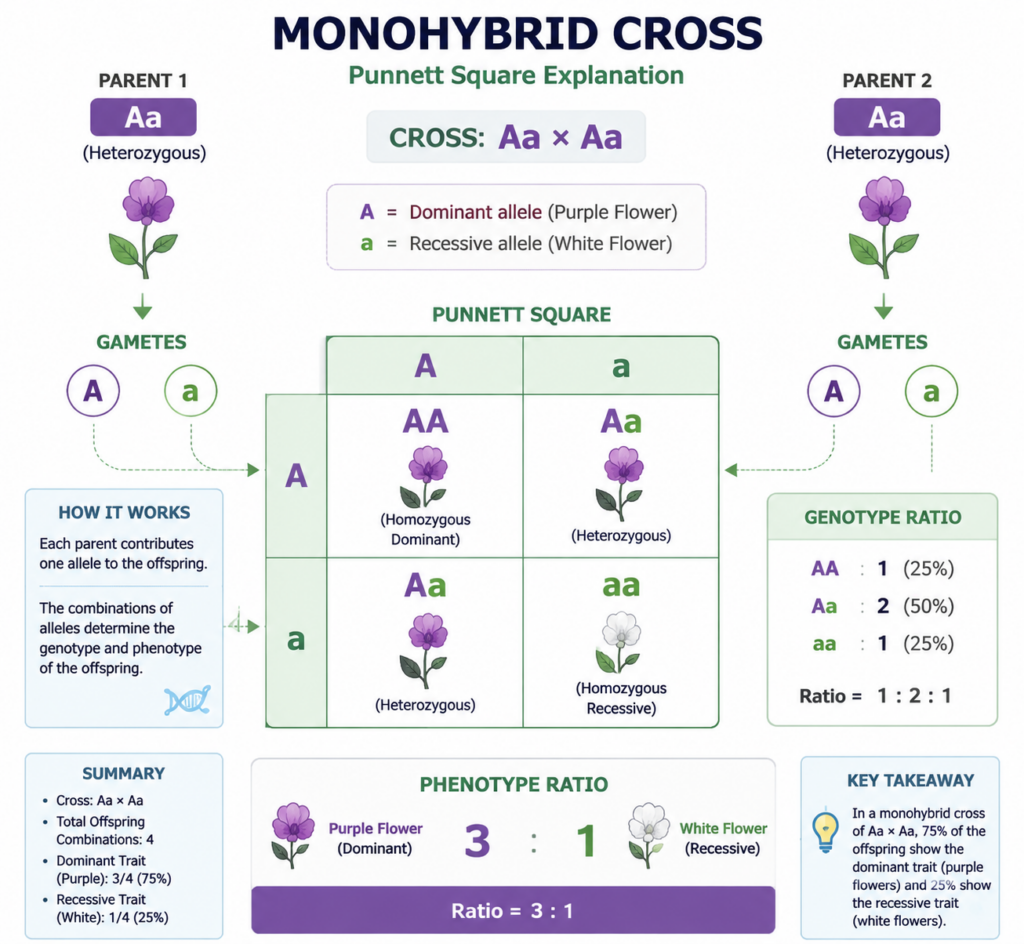
Example 1: Monohybrid Cross (Aa × Aa)
When both parents are heterozygous:
Possible offspring:
- AA → 25%
- Aa → 50%
- aa → 25%
Phenotype ratio:
- 3 dominant : 1 recessive
This is one of the most common examples used in school biology.
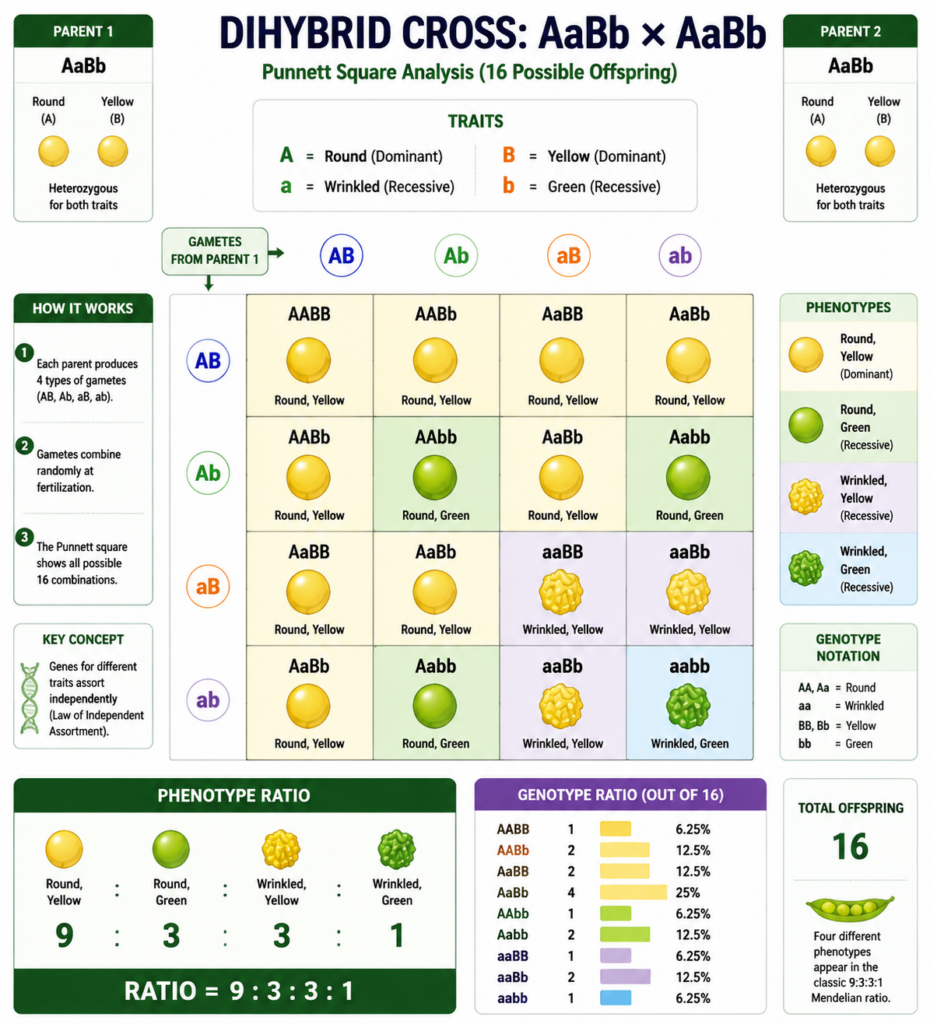
Example 2: Dihybrid Cross (AaBb × AaBb)
For two traits:
- A/a (Trait 1)
- B/b (Trait 2)
The calculator produces 16 possible combinations.
Typical phenotype ratio:
- 9 : 3 : 3 : 1
This helps explain independent assortment, a key concept in genetics introduced by Mendel.
Why Use a Punnett Square Calculator?
A manual Punnett square can be time-consuming, especially for dihybrid crosses. A digital tool offers several advantages:
✔ Saves Time
No manual grid drawing needed.
✔ Reduces Errors
Automated calculations avoid human mistakes.
✔ Easy Learning
Visual representation helps students understand inheritance.
✔ Instant Ratios
Genotype and phenotype percentages are shown immediately.
Biological Concepts Behind This Tool
To fully understand this calculator, you should know a few basic genetics terms:
Gene
A segment of DNA controlling a trait.
Allele
Different versions of a gene (A or a).
Genotype
Genetic makeup (Aa, AA, aa).
Phenotype
Observable trait (eye color, height, etc.).
This tool is aligned with Mendelian genetics principles studied in school biology and supported by modern genetics education.
Who Should Use This Calculator?
This tool is useful for:
- Biology students
- Teachers creating classroom examples
- Competitive exam aspirants
- Genetics researchers (basic modeling)
- Anyone learning heredity concepts
Advantages Over Manual Punnett Squares
Traditional method:
- Draw grid
- Manually fill combinations
- Calculate ratios yourself
This calculator:
- Automates all steps
- Handles both mono & dihybrid crosses
- Gives instant phenotype breakdown
Frequently Asked Questions (FAQ)
What is a Punnett Square Calculator used for?
It is used to predict the probability of offspring traits based on parental genotypes.
Can this calculator handle dihybrid crosses?
Yes, it supports both monohybrid and dihybrid genetic crosses.
What do uppercase and lowercase letters mean?
Uppercase represents dominant alleles, while lowercase represents recessive alleles.
Is the 3:1 ratio always guaranteed?
No, it depends on the genotype combination of parents.
Can this be used for exams?
Yes, it is ideal for learning and verifying genetic cross problems.
Does it work for all organisms?
Yes, it follows Mendelian genetics, applicable to most basic inheritance patterns.
Educational Importance of Punnett Squares
Punnett squares are a foundational concept in biology because they explain how traits are inherited from one generation to another. They are especially important in:
- Understanding genetic probability
- Studying hereditary diseases
- Learning plant and animal breeding
- Exploring evolutionary biology
Modern tools like this calculator simplify these concepts significantly, making genetics more accessible.
Practical Applications
Punnett squares are not just theoretical. They are widely used in:
- Agriculture (crop improvement)
- Animal breeding
- Medical genetics
- Genetic counseling
For example, predicting the likelihood of a child inheriting a recessive disorder is based on the same principles used in this calculator.
References
- Mendel’s Laws of Inheritance – OpenStax Biology
https://openstax.org/books/biology-2e/pages/12-1-mendels-experiments-and-the-laws-of-inheritance - Punnett Square Explanation – Khan Academy Genetics
https://www.khanacademy.org/science/ap-biology/heredity/mendelian-genetics/a/punnett-squares - Basic Genetics & Heredity – Nature Education (Scitable)
https://www.nature.com/scitable/topicpage/genetics-459/ - Introduction to Genetics – Encyclopaedia Britannica
https://www.britannica.com/science/genetics
Disclaimer
This Punnett Square Calculator is intended for educational and informational purposes only. It is based on simplified Mendelian genetics and may not represent complex real-world genetic interactions such as gene linkage, epigenetics, or environmental effects.
Final Note
This Punnett square calculator online is designed to make genetics intuitive and fast. Whether you’re a student learning Mendel’s laws or someone revising for exams, it helps you visualize inheritance patterns without manual effort.