

Modulo Calculator
The Modulo Calculator is a simple yet extremely useful mathematical tool designed to calculate the remainder when one number is divided by another. Whether you are a student solving arithmetic problems, a programmer working with algorithms, or someone dealing with modular arithmetic in cryptography, this calculator helps you get instant and accurate results.
The modulo operation is widely used in mathematics, computer science, coding, encryption systems, cyclic processes, and even time calculations. Instead of manually dividing numbers and finding remainders, this calculator automates the process and eliminates errors.
The calculator code provided includes an easy-to-use interface with instant calculation functionality and validation checks for incorrect values.
Table of Contents
What Is a Modulo Operation?
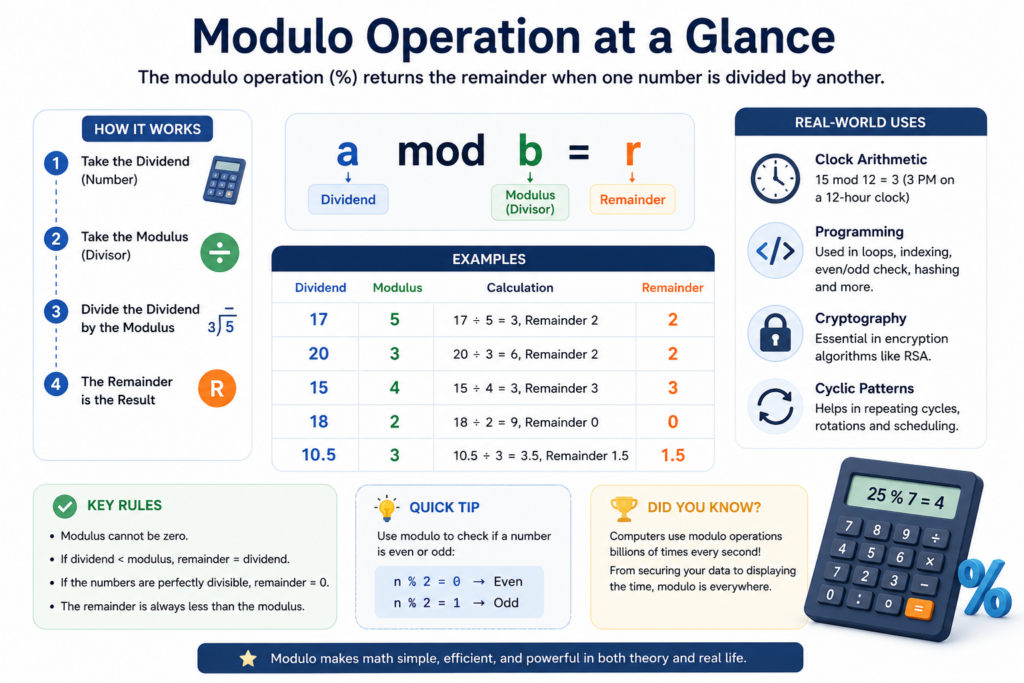
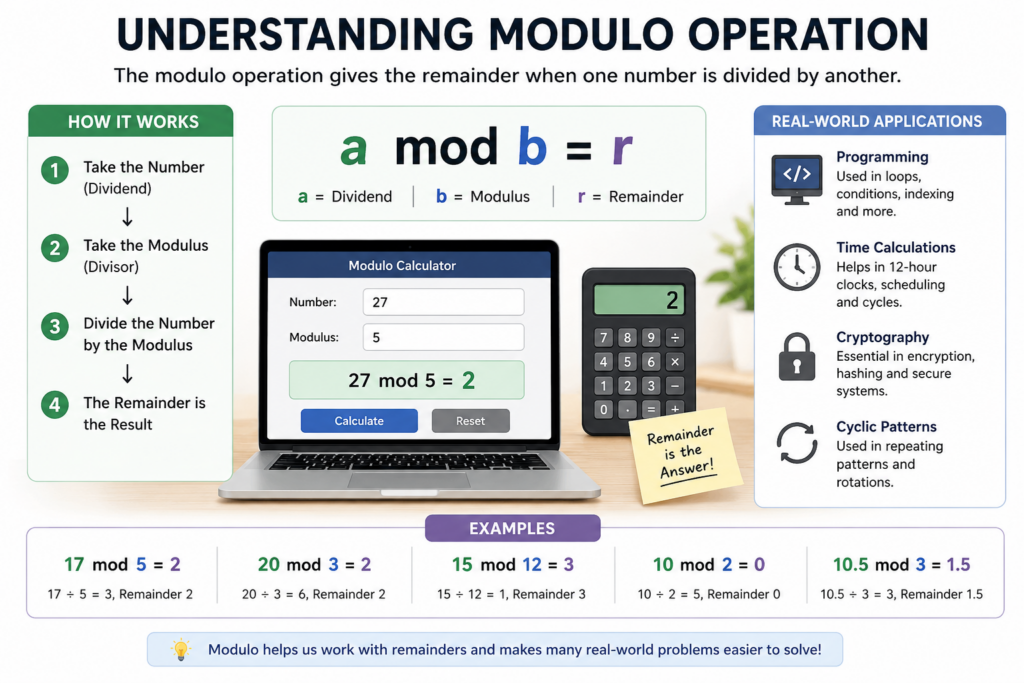
A modulo operation determines the remainder after dividing one number by another.
The formula is:
amodb=r
Where:
- a = dividend
- b = divisor or modulus
- r = remainder
For example:
17mod5=2
This means when 17 is divided by 5, the remainder is 2.
Modulo arithmetic is often referred to as “clock arithmetic” because numbers wrap around after reaching a specific value.
How the Modulo Calculator Works
This mod calculator online takes two inputs:
- The number (dividend)
- The modulus (divisor)
After clicking the calculate button, the calculator instantly computes the remainder using the modulo operator.
The calculator also includes:
- Error handling for invalid inputs
- Zero modulus protection
- Automatic formatting for decimal and large values
- Mobile-friendly responsive design
Because the tool uses JavaScript for calculations, results are generated instantly without page reloads.
Steps to Use This Calculator
Using this remainder calculator is extremely simple.
Step 1: Enter the Number
Type the dividend value into the “Number” field.
Example:
- 45
Step 2: Enter the Modulus
Type the divisor value into the “Modulus” field.
Example:
- 7
Step 3: Click Calculate
Press the Calculate button.
Step 4: View the Result
The calculator will display:
45mod7=3
Why Modulo Calculations Matter
Modulo operations are used far more often than most people realize. Here are some common real-world applications.
1. Programming and Software Development
Most programming languages use the modulo operator %.
Developers use it for:
- Checking even or odd numbers
- Loop control
- Hash functions
- Data indexing
- Game development
Example:
10 % 2 = 0This indicates that 10 is an even number.
2. Time and Clock Calculations
Modulo arithmetic is heavily used in time systems.
For example:
15mod12=3
This explains why 15 hours on a 12-hour clock becomes 3 PM.
3. Cryptography and Security
Modern encryption systems rely heavily on modular arithmetic.
Applications include:
- RSA encryption
- Secure authentication
- Blockchain technology
- Digital signatures
Without modulo operations, modern internet security would not function properly.
4. Mathematics and Number Theory
Mathematicians use modulo operations for:
- Congruence relations
- Prime number studies
- Cyclic patterns
- Modular equations
Examples of Modulo Calculations
Below are several examples to help you understand the concept better.
Example 1: Basic Integer Modulo
25mod4=1
Explanation:
- 4 × 6 = 24
- Remainder = 1
Example 2: Even Number Check
18mod2=0
Since the remainder is 0, the number is even.
Example 3: Odd Number Check
19mod2=1
Since the remainder is 1, the number is odd.
Example 4: Decimal Values
10.5mod3=1.5
The calculator also supports decimal operations.
Understanding Modular Arithmetic
Modular arithmetic works on repeating cycles.
Think of a clock:
- After 12 comes 1
- After 24 hours comes 0 again
This cyclical behavior forms the basis of modular systems.
For example:
29mod12=5
Meaning:
- 29 hours corresponds to 5 o’clock on a 12-hour clock.
Difference Between Division and Modulo
Many people confuse division with modulo.
Division
Division gives the quotient.
Example:
20 ÷ 6 = 3.33Modulo
Modulo gives the remainder.
20mod6=2
Both operations are related but provide different outputs.
Benefits of Using an Online Modulo Calculator
Using a dedicated modular arithmetic calculator provides several advantages.
Faster Calculations
No manual work is required.
Accurate Results
Avoid calculation mistakes.
Supports Large Numbers
Useful for coding and cryptography.
Beginner Friendly
Simple interface for students and non-technical users.
Mobile Responsive
Works across desktops, tablets, and smartphones.
Common Modulo Rules
Here are some important modulo properties.
Rule 1: Modulus Cannot Be Zero
amod0 is undefined
The calculator automatically prevents this error.
Rule 2: Smaller Dividend
If the dividend is smaller than the modulus:
3mod5=3
The remainder remains the original number.
Rule 3: Exact Division
If perfectly divisible:
24mod6=0
The remainder becomes zero.
Modulo in Programming Languages
Different programming languages support modulo operations.
JavaScript
10 % 3Python
10 % 3Java
10 % 3C++
10 % 3The result in all cases is:
1Practical Uses of Modulo Operations
Random Number Generation
Used in gaming and simulations.
Pagination Systems
Websites use modulo to distribute data evenly.
Cyclic Scheduling
Task rotation systems use modular arithmetic.
Data Structures
Hash tables often rely on modulo functions.
Tips for Using Modulo Correctly
- Always ensure the modulus is not zero.
- Understand that modulo returns remainders, not quotients.
- Be cautious with negative numbers because programming languages may handle them differently.
- Use online tools for large calculations to avoid mistakes.
Frequently Asked Questions (FAQ)
What does mod mean in math?
“Mod” stands for modulo, which represents the remainder after division.
Is modulo the same as division?
No. Division gives the quotient, while modulo gives the remainder.
Can modulo work with decimal numbers?
Yes. This calculator supports decimal inputs.
Why is modulo important in programming?
Programmers use modulo for loops, indexing, cryptography, and conditional logic.
What happens if the modulus is zero?
Modulo by zero is undefined and cannot be calculated.
Can I use this calculator on mobile devices?
Yes. The calculator is fully responsive and works on smartphones and tablets.
Reference Links
Disclaimer
This modulo calculator is intended for educational, informational, and general computational purposes only. While every effort has been made to ensure calculation accuracy, users should independently verify critical mathematical or programming-related computations before using them in academic, financial, engineering, or security-sensitive applications.
Final Thoughts
A Modulo Calculator is a fast and reliable tool for finding remainders and understanding modular arithmetic concepts. Whether you are solving classroom problems, writing code, managing cyclic systems, or learning number theory, this calculator makes the process quick and error-free.
Because modulo operations are deeply integrated into modern computing and mathematics, understanding how they work can improve both problem-solving skills and programming knowledge.
By using this calculator regularly, users can better understand:
- Remainder calculations
- Modular arithmetic
- Programming logic
- Cyclic mathematical systems
- Real-world applications of modulo operations