
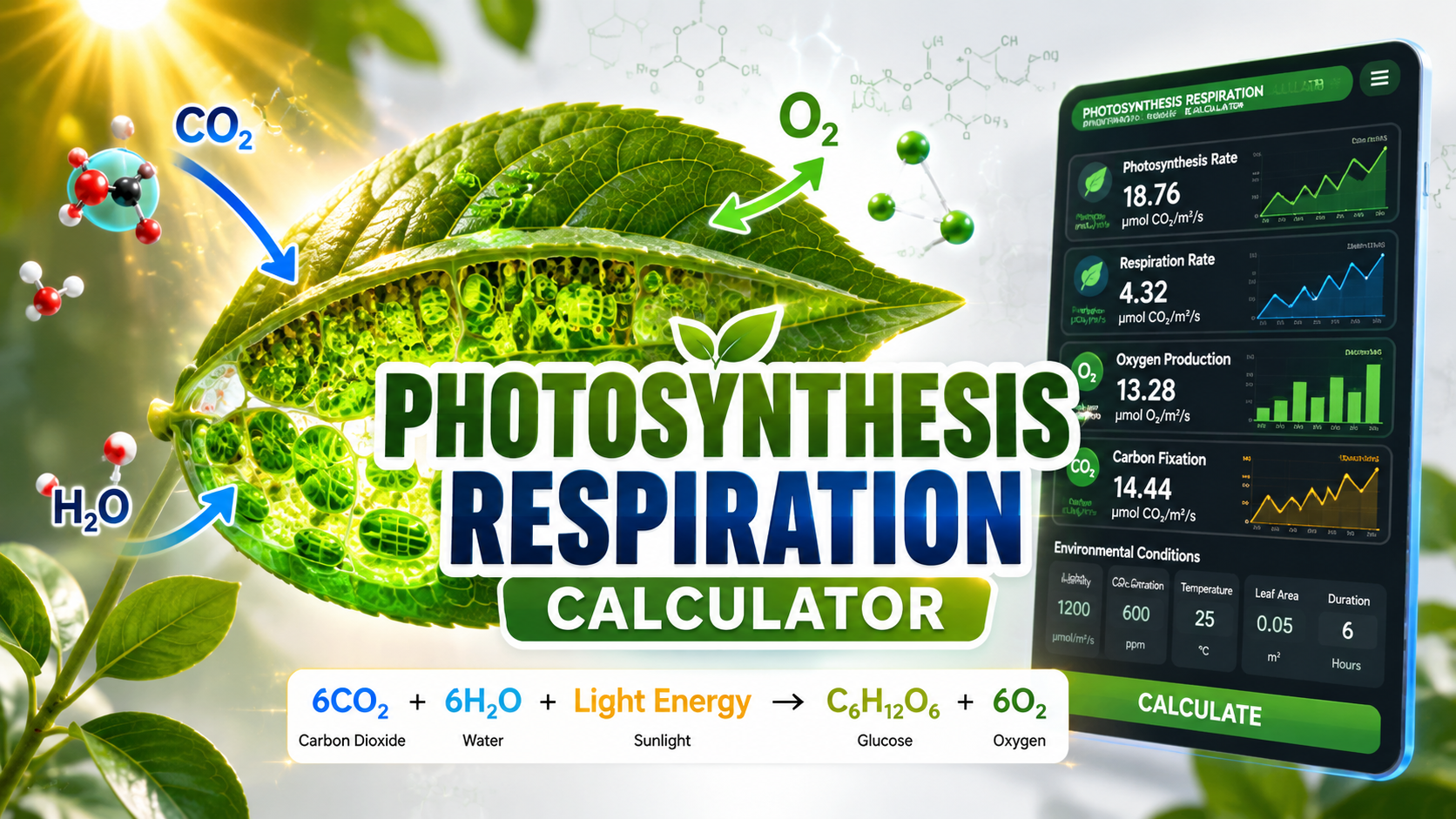
Photosynthesis Respiration Calculator – Calculate Net Photosynthesis, Oxygen Production & Carbon Fixation
Plants are the foundation of life on Earth. Every day, billions of plants convert sunlight into energy while releasing oxygen that supports nearly every living organism. At the same time, these plants also perform respiration, a process that consumes oxygen and releases carbon dioxide. Understanding how these two biological processes work together can sometimes be confusing, especially when environmental factors such as light intensity, temperature, and carbon dioxide concentration change.
That's where our Photosynthesis Respiration Calculator becomes useful.
This interactive calculator helps students, teachers, researchers, gardeners, and agriculture professionals estimate the relationship between photosynthesis and respiration under different environmental conditions. Instead of manually performing complex calculations, you can instantly determine gross photosynthesis, respiration rate, net photosynthesis, oxygen production, carbon dioxide fixation, and glucose synthesis with just a few inputs.
Whether you're preparing for biology exams, conducting a classroom experiment, studying plant physiology, or simply curious about how plants respond to changing environmental conditions, this photosynthesis calculator provides quick and easy estimates based on established scientific models.
In this guide, you'll learn how photosynthesis and respiration work, how the calculator estimates plant activity, and why understanding these processes is important in biology, agriculture, and environmental science.
Table of Contents
What is Photosynthesis?
Photosynthesis is the biological process through which green plants, algae, and certain bacteria convert sunlight into chemical energy. During this process, plants absorb carbon dioxide (CO₂) from the atmosphere and water (H₂O) from the soil. Using sunlight captured by chlorophyll inside chloroplasts, plants produce glucose while releasing oxygen as a by-product.
The simplified photosynthesis equation is:
6CO₂ + 6H₂O + Light Energy → C₆H₁₂O₆ + 6O₂
This equation represents one of the most important natural processes on Earth. Without photosynthesis:
- Plants would not produce food.
- Oxygen levels would rapidly decrease.
- Carbon dioxide would continue accumulating.
- Most ecosystems would collapse.
Nearly every food chain ultimately depends on photosynthesis. Herbivores consume plants, carnivores consume herbivores, and humans rely on both directly and indirectly for food, oxygen, and environmental stability.
Why is Photosynthesis Important?
Photosynthesis provides several essential benefits for life on Earth.
Produces Oxygen
Nearly all atmospheric oxygen originates from photosynthetic organisms. Every breath humans take depends on continuous oxygen production by plants, algae, and phytoplankton.
Removes Carbon Dioxide
Plants naturally absorb carbon dioxide during photosynthesis. This helps regulate Earth's climate by reducing greenhouse gases.
Produces Food
Glucose produced during photosynthesis serves as the primary energy source for plants. Excess glucose is stored as starch or used to build cellulose, proteins, and fats.
Supports Agriculture
Crop yield largely depends on photosynthesis efficiency. Farmers often optimize light exposure, irrigation, fertilization, and greenhouse conditions to maximize photosynthetic activity.
Maintains Ecological Balance
Healthy forests, grasslands, wetlands, and oceans depend on photosynthesis to maintain biodiversity and ecological stability.
What is Respiration in Plants?
Unlike photosynthesis, respiration occurs continuously throughout the day and night.
Respiration is the process by which plants break down stored glucose to release energy required for growth, repair, nutrient transport, flowering, fruit production, and other cellular activities.
The respiration equation is:
C₆H₁₂O₆ + 6O₂ → 6CO₂ + 6H₂O + Energy (ATP)
Notice that respiration is essentially the reverse of photosynthesis.
Instead of storing energy, respiration releases energy.
Plants need this energy to:
- Grow new leaves
- Develop roots
- Produce flowers
- Repair damaged cells
- Transport nutrients
- Maintain cellular functions
Because respiration occurs both day and night, plants consume oxygen continuously.
Photosynthesis vs Respiration
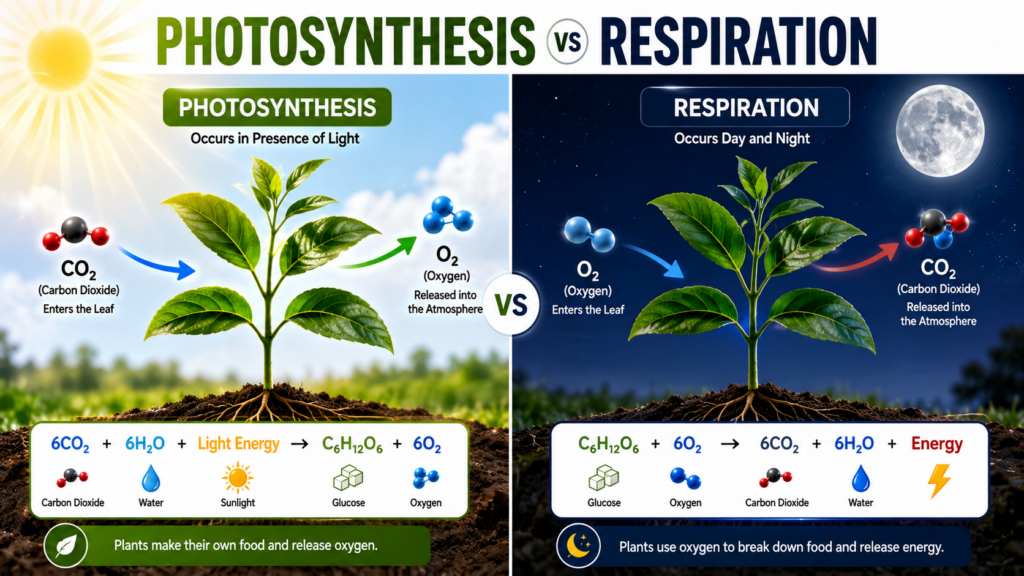
Although these two processes are closely related, they perform opposite functions.
| Photosynthesis | Respiration |
|---|---|
| Requires sunlight | Occurs day and night |
| Absorbs CO₂ | Releases CO₂ |
| Releases O₂ | Uses O₂ |
| Produces glucose | Breaks down glucose |
| Stores energy | Releases energy |
| Takes place in chloroplasts | Takes place in mitochondria |
During daylight, photosynthesis usually exceeds respiration, resulting in positive carbon gain.
At night, photosynthesis stops because there is no sunlight, but respiration continues. As a result, plants release carbon dioxide until daylight returns.
Understanding Net Photosynthesis
One of the most important concepts in plant biology is net photosynthesis.
Plants don't simply photosynthesize.
They simultaneously perform respiration.
Therefore,
Net Photosynthesis = Gross Photosynthesis − Respiration
For example:
- Gross photosynthesis = 20 μmol CO₂/m²/s
- Respiration = 4 μmol CO₂/m²/s
Net Photosynthesis:
20 − 4 = 16 μmol CO₂/m²/s
A positive value indicates that the plant is storing carbon and growing efficiently.
A negative value indicates that respiration exceeds photosynthesis, meaning the plant is losing stored energy.
This is why many scientists and students prefer using a net photosynthesis calculator, as manually calculating changing environmental conditions can become time-consuming.
How Does This Photosynthesis Respiration Calculator Work?
Our Photosynthesis Respiration Calculator combines several scientific relationships to estimate how efficiently a leaf performs photosynthesis under different environmental conditions.
Instead of relying on a single equation, the calculator models plant responses using parameters such as:
- Light intensity (PAR)
- Carbon dioxide concentration
- Leaf temperature
- Leaf area
- Duration of exposure
- Quantum yield
- Maximum photosynthetic rate
- Respiration rate
- Temperature response
- Plant type (C3, C4, or CAM)
Using these inputs, the calculator estimates:
- Gross photosynthesis
- Dark respiration
- Net photosynthesis
- Carbon dioxide fixation
- Oxygen production
- Glucose synthesis
- Light compensation point
- Light saturation point
Because all calculations update instantly, users can quickly compare how changing environmental conditions affect plant productivity.
What Does the Calculator Measure?
The calculator provides multiple outputs that help users understand plant performance more effectively.
Gross Photosynthesis
Gross photosynthesis represents the total amount of carbon dioxide fixed before accounting for respiration losses.
Respiration Rate
This shows how much stored energy the plant consumes during cellular respiration.
Net Photosynthesis
This is the most useful value because it reflects the plant's actual carbon gain after subtracting respiration.
Oxygen Production
As plants absorb carbon dioxide, they release oxygen. The calculator estimates oxygen production based on photosynthetic activity.
Carbon Dioxide Fixation
This value estimates how much atmospheric carbon dioxide is absorbed by the leaf over the selected duration.
Glucose Production
The calculator estimates glucose synthesis using the stoichiometric relationship between carbon fixation and sugar production.
Who Can Use This Calculator?
The Photosynthesis Respiration Calculator is suitable for a wide range of users, including:
- Biology students
- School teachers
- College professors
- Agricultural researchers
- Greenhouse managers
- Environmental scientists
- Forestry professionals
- Gardeners and hobbyists
- Competitive exam aspirants
- Anyone interested in plant physiology
Because the interface is simple and interactive, both beginners and advanced users can quickly understand how environmental conditions influence plant growth.
Steps to Use the Photosynthesis Respiration Calculator
Our Photosynthesis Respiration Calculator is designed to be intuitive, allowing you to estimate photosynthesis, respiration, oxygen production, carbon fixation, and glucose synthesis without performing complex biological calculations manually.
Follow these simple steps:
Step 1: Select the Plant Type
Start by choosing the type of plant:
- C3 Plant – Most crops and trees such as wheat, rice, soybean, sunflower, and oak.
- C4 Plant – Plants adapted to warm climates, including maize (corn), sugarcane, and sorghum.
- CAM Plant – Desert plants such as cactus, aloe vera, and pineapple.
Selecting the correct plant type automatically adjusts physiological parameters to better reflect typical plant behavior.
Step 2: Adjust the Light Intensity
Use the Light Intensity (PAR) slider.
Light intensity is measured in µmol photons m⁻² s⁻¹ and represents the amount of photosynthetically active radiation reaching the leaf.
Typical values include:
- 0 = Complete darkness
- 200 = Heavy shade
- 500 = Cloudy daylight
- 1000 = Bright daylight
- 1500–2000 = Direct summer sunlight
Increasing light generally increases photosynthesis until the plant reaches its saturation point.
Step 3: Enter the Carbon Dioxide Concentration
Move the CO₂ concentration slider.
Typical atmospheric CO₂ is approximately 420 ppm.
Greenhouses often maintain:
- 600 ppm
- 800 ppm
- 1000 ppm
Higher carbon dioxide concentrations generally improve photosynthesis until another factor becomes limiting.
Step 4: Set the Leaf Temperature
Choose the approximate leaf temperature.
Temperature strongly affects enzyme activity involved in photosynthesis.
General ranges are:
- 10°C – Slow metabolism
- 20–30°C – Near optimum for many plants
- Above 35°C – Photosynthesis often declines
- Above 40°C – Heat stress becomes significant
The calculator automatically adjusts photosynthesis and respiration according to temperature.
Step 5: Enter Leaf Area
Input the total leaf area in square metres.
A larger leaf captures more sunlight and fixes more carbon dioxide, resulting in greater oxygen and glucose production over the selected time period.
Step 6: Choose the Duration
Specify how long the plant experiences the selected environmental conditions.
Examples include:
- 1 hour
- 3 hours
- 6 hours
- 12 hours
Longer durations increase the total estimated carbon fixation, oxygen release, and glucose production.
Step 7: Explore Advanced Parameters (Optional)
Advanced users can modify additional physiological variables such as:
- Quantum Yield (α)
- Maximum Photosynthetic Rate (Pmax)
- Curvature (θ)
- Respiration Rate (Rd)
- Q10 Temperature Coefficient
- Optimum Temperature
These settings are primarily intended for research, teaching, and advanced plant physiology studies.
Most users can leave the default values unchanged.
Step 8: Read the Results
The calculator instantly updates several important outputs:
- Gross Photosynthesis
- Dark Respiration
- Net Photosynthesis
- Carbon Dioxide Fixed
- Oxygen Released
- Glucose Synthesized
- Light Compensation Point
- Light Saturation Point
This allows you to compare different environmental conditions within seconds.
Understanding the Results
Each output represents a different aspect of plant metabolism.
Gross Photosynthesis
Gross photosynthesis represents the total carbon dioxide absorbed before subtracting respiration losses.
Higher values indicate that the plant is efficiently converting sunlight into chemical energy.
Respiration
Respiration measures the amount of glucose consumed by the plant to produce energy.
Unlike photosynthesis, respiration occurs throughout the day and night.
As temperature increases, respiration generally increases as well.
Net Photosynthesis
Net photosynthesis is the most important measurement.
It is calculated as:
Net Photosynthesis = Gross Photosynthesis − Respiration
Interpretation:
- Positive value → Plant is gaining carbon.
- Zero → Photosynthesis equals respiration.
- Negative value → Plant loses more energy than it produces.
This is why many researchers use a net photosynthesis calculator when evaluating plant growth.
Oxygen Released
For every molecule of carbon dioxide fixed during photosynthesis, oxygen is released.
Higher oxygen production generally indicates more active photosynthesis.
Carbon Dioxide Fixed
This value estimates how much atmospheric CO₂ has been absorbed by the plant during the selected duration.
It is useful in environmental studies and carbon sequestration research.
Glucose Synthesized
Photosynthesis ultimately produces glucose.
The calculator estimates glucose production using the standard stoichiometric relationship from the photosynthesis equation.
Scientific Formula Behind the Calculator
The calculator combines several biological models instead of relying on a single equation.
The fundamental photosynthesis equation is:
6CO₂ + 6H₂O + Light → C₆H₁₂O₆ + 6O₂
Respiration follows the reverse reaction:
C₆H₁₂O₆ + 6O₂ → 6CO₂ + 6H₂O + ATP
The calculator also estimates:
- Light-response curves
- Carbon dioxide response
- Temperature response
- Dark respiration
- Net carbon fixation
These models provide educational estimates rather than laboratory-grade measurements.
C3 vs C4 vs CAM Plants
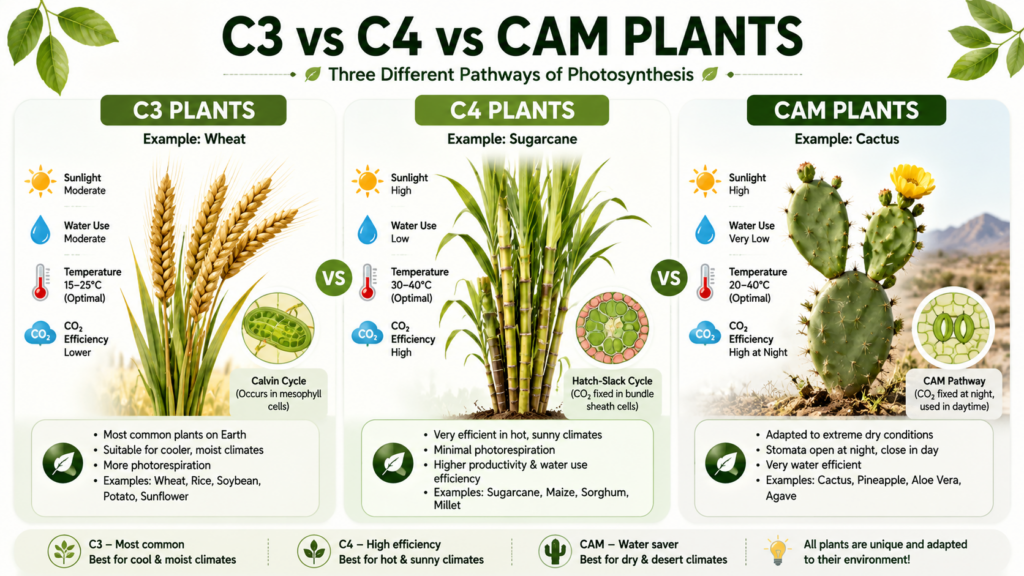
Different plants perform photosynthesis differently.
Understanding these categories helps interpret the calculator's results more accurately.
C3 Plants
Examples:
- Rice
- Wheat
- Soybean
- Cotton
- Potato
Characteristics:
- Most common photosynthetic pathway
- Performs well in moderate climates
- Less efficient under high temperatures
- More susceptible to photorespiration
C4 Plants
Examples:
- Maize
- Sugarcane
- Sorghum
- Millet
Characteristics:
- Better adapted to hot climates
- More efficient carbon fixation
- Reduced photorespiration
- Higher productivity under strong sunlight
CAM Plants
Examples:
- Cactus
- Pineapple
- Aloe Vera
- Agave
Characteristics:
- Open stomata mainly at night
- Minimize water loss
- Highly drought tolerant
- Grow well in desert conditions
Selecting the correct plant type ensures the calculator produces more realistic estimates.
Practical Examples
Example 1: Wheat Crop
Inputs:
- Plant Type: C3
- Light: 900 µmol
- CO₂: 420 ppm
- Temperature: 25°C
Result:
The calculator predicts positive net photosynthesis, indicating healthy growth under favorable conditions.
Example 2: Greenhouse Tomato Plant
Inputs:
- CO₂: 900 ppm
- Temperature: 24°C
- Light: 1200 µmol
Result:
Elevated carbon dioxide significantly increases carbon fixation and glucose production.
Example 3: Sugarcane Field
Inputs:
- Plant Type: C4
- Light: 1600 µmol
- Temperature: 32°C
Result:
Sugarcane maintains high photosynthetic efficiency even under intense sunlight and warm temperatures.
Example 4: Desert Cactus
Inputs:
- Plant Type: CAM
- Temperature: 38°C
- Moderate light
Result:
The calculator reflects lower daytime photosynthesis but improved water-use efficiency compared to many other plants.
Example 5: Low-Light Indoor Plant
Inputs:
- Light: 120 µmol
- CO₂: 400 ppm
- Temperature: 20°C
Result:
Photosynthesis may barely exceed respiration, producing only a small positive net carbon gain.
Factors That Affect Photosynthesis
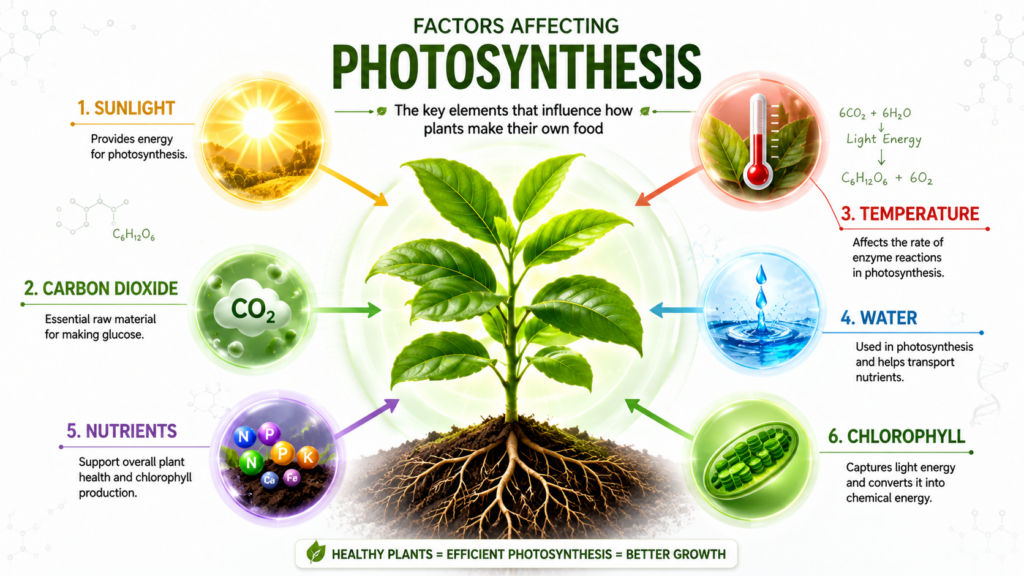
Several environmental factors influence the rate of photosynthesis.
1. Light Intensity
Light supplies the energy required for photosynthesis.
Too little light limits glucose production, while excessive light eventually reaches saturation.
2. Carbon Dioxide Concentration
Carbon dioxide acts as a raw material.
Increasing CO₂ generally increases photosynthesis until enzyme capacity becomes limiting.
3. Temperature
Photosynthetic enzymes perform best within an optimal temperature range.
Both very low and very high temperatures reduce efficiency.
4. Water Availability
Water is essential for photosynthesis.
Drought causes stomata to close, reducing carbon dioxide uptake.
5. Plant Species
Different species respond differently to identical environmental conditions.
C4 plants generally outperform C3 plants in hot climates, while CAM plants excel in arid environments.
6. Leaf Age
Young, healthy leaves usually photosynthesize more efficiently than older or damaged leaves.
7. Nutrient Availability
Nitrogen, magnesium, phosphorus, and iron are required for chlorophyll production and enzyme function.
Deficiencies reduce photosynthetic efficiency.
Common Mistakes When Using a Photosynthesis Calculator
To obtain more realistic estimates, avoid these common mistakes:
- Selecting the wrong plant type.
- Entering unrealistic light intensity values.
- Assuming atmospheric CO₂ remains constant in all environments.
- Ignoring the effect of temperature on respiration.
- Confusing gross photosynthesis with net photosynthesis.
- Using laboratory estimates as exact real-world measurements.
Remember that the calculator is intended for educational and estimation purposes. Actual plant performance depends on many additional factors, including humidity, wind, nutrient status, leaf age, disease, and species-specific characteristics.
Real-World Applications of the Photosynthesis Respiration Calculator
Although the Photosynthesis Respiration Calculator is easy to use, it is based on scientific principles that make it useful in many practical situations. From classroom demonstrations to agricultural research, this calculator helps users understand how plants respond to changing environmental conditions.
1. Biology Education
Teachers can use the calculator to demonstrate how environmental factors influence plant metabolism without requiring expensive laboratory equipment.
Students can:
- Compare C3, C4, and CAM plants.
- Observe the effect of increasing light intensity.
- Study the relationship between photosynthesis and respiration.
- Learn about limiting factors in plant growth.
- Understand net photosynthesis through interactive examples.
Interactive learning often helps students grasp complex biological concepts more effectively than static textbook diagrams.
2. Agriculture
Crop productivity depends heavily on photosynthesis.
Farmers and agricultural students can use this calculator to understand how different environmental conditions may affect crop performance.
Examples include:
- Evaluating greenhouse CO₂ enrichment.
- Comparing crop responses during different seasons.
- Understanding heat stress effects.
- Learning how light influences plant growth.
- Studying carbon fixation in various crop species.
While the calculator should not replace field measurements, it serves as an excellent educational and planning tool.
3. Greenhouse Management
Modern greenhouses carefully regulate environmental conditions to maximize plant growth.
Growers frequently monitor:
- Carbon dioxide concentration
- Artificial lighting
- Temperature
- Irrigation schedules
Using a photosynthesis calculator, growers can better understand why these factors matter and how they influence plant productivity.
4. Environmental Science
Photosynthesis plays a major role in regulating Earth's carbon cycle.
Environmental scientists study carbon fixation to understand:
- Climate change
- Carbon sequestration
- Forest productivity
- Ecosystem health
- Atmospheric carbon dioxide removal
This calculator provides a simplified way to visualize these concepts.
5. Forestry
Forest managers often study photosynthesis when evaluating:
- Tree growth
- Forest carbon storage
- Reforestation projects
- Climate adaptation strategies
Healthy forests remove billions of tonnes of carbon dioxide from the atmosphere every year.
6. Competitive Exam Preparation
Students preparing for competitive examinations such as:
- NEET
- ICAR
- CUET
- UPSC
- State PSC
- Agriculture entrance examinations
can use the calculator alongside theoretical concepts to strengthen their understanding of plant physiology.
Benefits of Using This Photosynthesis Respiration Calculator
There are many advantages to using an interactive calculator instead of solving equations manually.
Some of the key benefits include:
- Free and easy to use.
- Instant calculations.
- No complex mathematical formulas required.
- Supports C3, C4, and CAM plants.
- Calculates multiple biological parameters simultaneously.
- Useful for students, teachers, and researchers.
- Provides educational estimates in real time.
- Helps visualize the relationship between photosynthesis and respiration.
Because the calculator updates instantly, users can quickly compare different environmental scenarios and better understand plant responses.
Frequently Asked Questions (FAQs)
What is a Photosynthesis Respiration Calculator?
A Photosynthesis Respiration Calculator is an educational tool that estimates gross photosynthesis, respiration, net photosynthesis, oxygen release, carbon dioxide fixation, and glucose synthesis based on environmental inputs such as light intensity, carbon dioxide concentration, temperature, leaf area, and duration.
What is the difference between gross and net photosynthesis?
Gross photosynthesis represents the total carbon dioxide fixed during photosynthesis.
Net photosynthesis is the amount remaining after subtracting respiration.
Net Photosynthesis = Gross Photosynthesis − Respiration
Does photosynthesis occur at night?
No.
Photosynthesis requires sunlight, so it stops during the night.
Respiration, however, continues throughout both day and night.
Why do plants respire if they already photosynthesize?
Photosynthesis stores energy as glucose.
Respiration breaks down that stored glucose to produce ATP, which powers growth, repair, nutrient transport, and other cellular activities.
Both processes are essential for plant survival.
Which plants perform photosynthesis more efficiently?
It depends on environmental conditions.
C3 plants perform well in moderate climates.
C4 plants are generally more efficient in hot, sunny environments.
CAM plants are highly adapted to dry conditions and conserve water by opening their stomata mainly at night.
Is this calculator scientifically accurate?
The calculator is based on accepted biological relationships and established scientific models. However, it provides educational estimates and should not be considered a replacement for laboratory measurements or field experiments.
Why is my net photosynthesis negative?
A negative value means the plant is using more energy through respiration than it is producing through photosynthesis.
This commonly occurs under:
Low light intensity
High temperatures
Extended darkness
Environmental stress
Why does increasing light stop increasing photosynthesis?
The light compensation point is the light intensity at which photosynthesis exactly equals respiration.
At this point:
Net photosynthesis = 0
No net carbon gain occurs.
Can this calculator be used for school and college projects?
Yes.
The calculator is well suited for classroom activities, biology assignments, science fairs, demonstrations, and educational presentations because it illustrates the interaction between photosynthesis and respiration in an easy-to-understand way.
References
The scientific concepts presented in this article are based on widely accepted plant physiology principles. For further reading, refer to the following authoritative resources:
- Campbell Biology (Pearson Education)
- Taiz & Zeiger – Plant Physiology and Development
- Raven Biology of Plants
- Food and Agriculture Organization (FAO) – https://www.fao.org/
- National Aeronautics and Space Administration (NASA Earth Observatory) – https://earthobservatory.nasa.gov/
- Encyclopaedia Britannica – https://www.britannica.com/science/photosynthesis
- Khan Academy Biology – https://www.khanacademy.org/science/biology
- National Center for Biotechnology Information (NCBI) – https://www.ncbi.nlm.nih.gov/
Disclaimer
This Photosynthesis Respiration Calculator is intended for educational, informational, and demonstration purposes only. The calculations are based on generalized physiological models and typical parameter values. Actual photosynthetic rates vary depending on plant species, genetics, leaf age, humidity, soil conditions, nutrient availability, water status, disease, atmospheric conditions, and numerous other environmental factors. The results should not be used as a substitute for laboratory measurements, field experiments, or professional agricultural recommendations.
Conclusion
Photosynthesis and respiration are two complementary biological processes that determine how plants capture, store, and use energy. While photosynthesis converts sunlight, carbon dioxide, and water into glucose and oxygen, respiration releases the stored energy needed for growth and survival. Together, these processes regulate plant productivity, influence global carbon cycling, and support nearly all life on Earth.
Our Photosynthesis Respiration Calculator simplifies these complex biological interactions by allowing you to estimate gross photosynthesis, respiration, net photosynthesis, oxygen production, carbon dioxide fixation, and glucose synthesis in just a few clicks. Whether you are a student learning plant physiology, a teacher explaining biological concepts, a researcher exploring environmental variables, or simply curious about how plants respond to different conditions, this tool offers a practical and interactive way to visualize plant metabolism.
Experiment with different light intensities, carbon dioxide levels, temperatures, and plant types to see how environmental changes influence photosynthetic performance. By understanding these relationships, you'll gain deeper insight into plant biology, sustainable agriculture, and the vital role plants play in maintaining Earth's ecosystems.